
Packing speed looks simple on paper, but shrimp chips can break, block, and slow down the full line if the system is not balanced.
An Indonesian shrimp chips factory reached 210+ bags per minute by using 4 sets of 14-head weighers with VFFS machines, 1 bucket conveyor, and 1 belt conveyor that distributes products to 4 weighers. This system improved speed, reduced labor pressure, and made the packing flow more stable.
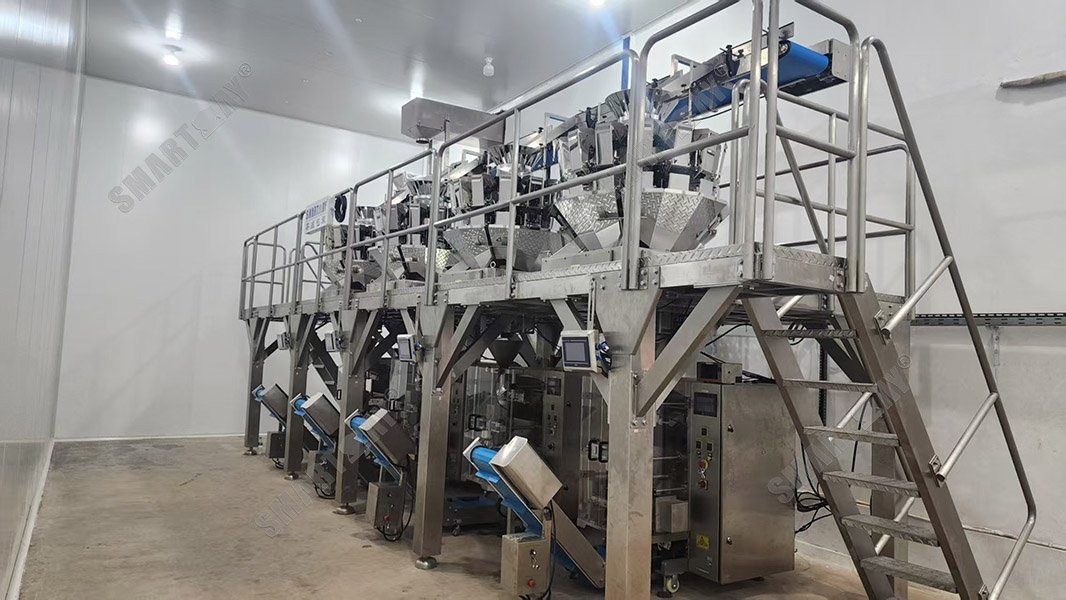
When I first discussed this project with the customer, I could feel one clear pressure from their side. Their production demand was growing, but the packing area could not follow the same speed. They did not only need a machine. They needed a complete system that could run in a real Indonesian snack factory, with real product behavior, real operators, and real daily production pressure.
Shrimp chips are not an easy product. They are light. They take up a lot of volume. They can break during transfer. They also need stable feeding before the weighing process. So, I did not treat this project as a normal packing machine order. I treated it as a full line design project.
The final solution used 4 sets of 14-head multihead weighers with VFFS packing machines, 1 bucket conveyor, and 1 belt conveyor to distribute shrimp chips to 4 weighers. The final running speed reached 210+ bags per minute.
What Was the Customer’s Main Packing Problem?
The customer had enough market demand, but the packing section became the bottleneck. The production side could make more shrimp chips, but the packing side could not handle the same output.
The main problem was not only low speed. The customer also faced unstable weighing, high labor pressure, product handling issues, and poor balance between production and packing. Automation helped the factory turn packing from a bottleneck into a controlled process.
In many Indonesian snack factories, I see the same problem again and again. The fryer, seasoning system, or production process can produce enough snacks. But when the products reach the packing room, everything becomes slower. Workers need to weigh, fill, seal, check, and move bags. This creates a lot of repeated work.
For shrimp chips, this problem is even more serious because the product is bulky and fragile. If workers handle it too much, the broken rate can increase. If the weighing is not stable, giveaway can increase. If packing speed is too low, the production team must wait or store semi-finished products.
| Problem Area | Before Automation | Impact on Factory |
|---|---|---|
| Packing speed | Manual or low-speed packing | Production output could not grow |
| Labor use | Many workers needed | Higher cost and harder management |
| Weight control | Less stable bag weight | More giveaway and more complaints |
| Product handling | More manual contact | Higher risk of breakage |
| Line balance | Packing slower than production | Bottleneck at the end of the process |
I always tell customers that automation should not only replace labor. It should remove the weak point in the whole flow. In this case, the weak point was not one worker or one machine. The weak point was the packing system as a whole. That is why we designed one integrated solution instead of selling one standalone machine.
What Machine Configuration Was Used in This Project?
The project used a 4-lane automatic weighing and packing system. Each lane had one 14-head weigher and one VFFS packing machine.
The complete configuration included 4 sets of 14-head weighers with VFFS machines, 1 bucket conveyor, and 1 belt conveyor. The bucket conveyor lifted shrimp chips, while the belt conveyor distributed products evenly to the 4 weighers.
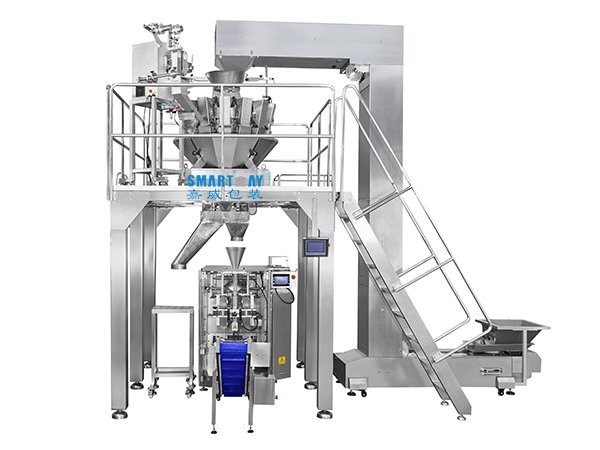
The system design was simple to understand, but it needed careful planning. The bucket conveyor lifted the shrimp chips from the lower feeding point to the upper distribution level. Then the belt conveyor moved the product across the 4 weighing points. Each 14-head weigher received product and completed fast combination weighing. After that, each VFFS machine formed the bag, filled the product, sealed the bag, and cut it.
| Machine Part | Quantity | Main Function |
|---|---|---|
| 14-head multihead weigher | 4 sets | Fast and accurate weighing |
| VFFS packing machine | 4 sets | Bag forming, filling, sealing, and cutting |
| Bucket conveyor | 1 set | Lifting shrimp chips to the upper feeding system |
| Belt conveyor | 1 set | Distributing shrimp chips to 4 weighers |
| Control system | Integrated | Coordinating product flow and machine operation |
This setup allowed the customer to reach 210+ bags per minute. The number is important, but the stability behind the number is more important. A machine can run fast for a short test. But a factory needs stable output during real shifts. So, the feeding flow, weighing logic, bagging speed, film control, sealing temperature, and operator habits all matter.
For this project, I focused on the balance between the 4 weighers. If one weigher has no product, that lane will wait. If one weigher receives too much product, the product may pile up. The belt conveyor was very important because it helped feed the 4 weighers as one complete system.
Why Did We Use 4 Sets of 14-Head Weigher with VFFS Machines?
We used 4 sets because the customer needed high output, and one weighing and packing lane could not meet the target alone.
A 14-head weigher with VFFS machine is suitable for snacks like shrimp chips because it can weigh fast, control bag weight, and connect directly with automatic vertical bag packing. Four lanes working together gave the customer enough total capacity.
A 14-head multihead weigher works by using different weighing combinations. It can choose the closest combination to the target weight. This helps reduce overweight giveaway and improve weight stability. For snack factories, this is very important because small weight differences can become large losses after thousands or millions of bags.
The VFFS machine is also important because it completes several steps in one process. It forms the bag from roll film. It receives product from the weigher. It fills the product into the bag. It seals and cuts the bag. This gives the factory a continuous packing process.
| Reason | Why It Matters |
|---|---|
| Higher total speed | 4 lanes work at the same time |
| Better weight control | 14-head weigher selects better combinations |
| Lower labor pressure | Less manual weighing and filling work |
| Stable production | Each lane supports continuous output |
| Flexible operation | One lane can be adjusted while others continue running |
In my experience, many customers first ask for “one fast machine.” But after we calculate their real target speed, product volume, bag size, and daily output, they understand that a multi-lane solution is better. For this Indonesian shrimp chips factory, 4 lanes made more sense. It gave the customer enough room for current orders and future growth.
I also like this design because it gives the production manager more control. During peak production, the factory can run all 4 lanes. During cleaning, testing, or small-batch work, the factory can manage lanes separately. This is useful for factories that have many SKUs or different bag sizes.
What Was the Specification of the Shrimp Chips Packing Line?
The specification had to match high speed, light product feeding, stable weighing, and continuous snack production. I used the standard logic of a snacks and nuts VFFS packing machine with a 14-head weigher, then adapted it to a 4-lane shrimp chips project.
The shrimp chips line used 4 automatic VFFS packing lanes with 14-head weighers. It was designed for snacks, nuts, puffed food, and light granular food. The line included automatic feeding, weighing, filling, sealing, cutting, and optional inspection functions.
The specification was not only a list of machine parts. It was also a production plan. The customer needed a line that could handle fragile shrimp chips without too much manual contact. They also needed stable speed and easy daily operation.
| Item | Specification |
|---|---|
| Product | Shrimp chips |
| Suitable Applications | Snacks, nuts, puffed food, chips, light granular food |
| Weighing System | 14-head multihead weigher |
| Packing System | VFFS vertical form fill seal machine |
| Number of Packing Lanes | 4 lanes |
| Total Running Speed | 210+ bags per minute |
| Feeding System | 1 bucket conveyor + 1 belt distribution conveyor |
| Distribution Method | Belt conveyor distributes products to 4 weighers |
| Bag Type | Pillow bag or customized bag style |
| Film Type | Roll film, based on customer package design |
| Main Operation | Automatic weighing, filling, bag forming, sealing, and cutting |
| Control System | PLC control with touch screen operation |
| Product Contact Material | Food-grade stainless steel contact parts |
| Optional Devices | Date printer, nitrogen filling, check weigher, metal detector |
| Factory Type | Medium to large snack factories with high daily output |
The 14-head weigher helped the customer keep the bag weight more stable. The VFFS machine helped the customer move away from slow manual packing. The bucket conveyor reduced manual lifting. The belt conveyor made product distribution more balanced.
I also considered future production needs. A good packing line should not only solve today’s problem. It should also support the next growth stage. This customer may add new bag sizes, new flavors, or new production shifts later. So, the line needed to be strong, clear, and easy for the local team to understand.
Why Was the Belt Conveyor So Important?
The belt conveyor was the key part that helped distribute shrimp chips to 4 weighers. Without good distribution, the 4-lane system could not keep stable speed.
The belt conveyor made the product flow more balanced. It helped prevent one weigher from having too much product while another weigher had too little. This helped the full line reach stable high-speed packing.
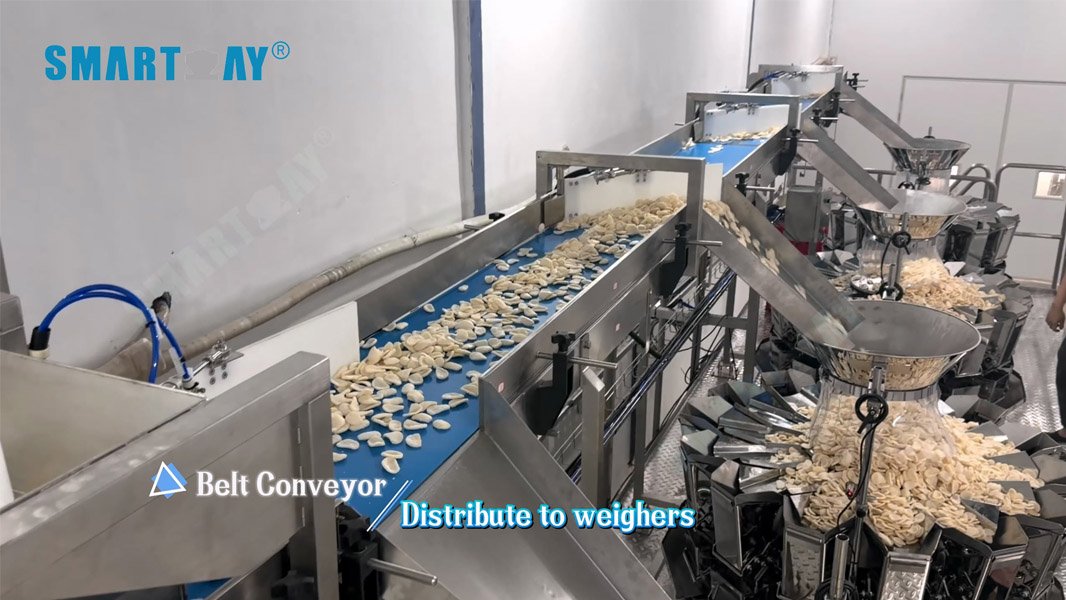
Many people look at the weigher and VFFS machine first. I understand that because those machines are the main visible parts. But in high-speed snack packing, the conveyor system can decide whether the full line runs well or not. Feeding is the start of everything.
Shrimp chips are light and bulky. They do not flow like sugar or rice. If the distribution is not controlled, one weigher may receive too much product. Another weigher may wait for product. The final speed will drop because the whole line cannot run evenly.
| Conveyor Role | Result in Production |
|---|---|
| Moves product across 4 weighing points | Each weigher gets product supply |
| Supports even feeding | Less waiting time |
| Reduces product pile-up | More stable operation |
| Connects upstream and downstream process | Better line balance |
| Reduces manual handling | Lower labor pressure |
I like to explain this to customers with a simple example. Four packing lanes are like four workers. If one worker has too much material and another worker has nothing to do, the team is not balanced. The belt conveyor helps the 4 weighers work like one team.
This is why the final speed reached 210+ bags per minute. It was not because one machine was fast. It was because the whole system was balanced. In real factory operation, balance is often more valuable than peak speed.
Why Did the Customer Need a Bucket Conveyor?
The bucket conveyor lifted shrimp chips from the lower feeding area to the upper distribution system. It helped reduce manual feeding and made the product supply more stable.
The bucket conveyor was needed because it lifted shrimp chips in a controlled way. It reduced manual handling, supported continuous feeding, and helped protect the product before it reached the distribution conveyor and weighers.
In many Indonesian factories, floor layout is not always perfect. Some factories have limited space. Some factories need to connect old production equipment with new packing machines. Some factories need to keep walking paths clear for workers. So, the conveyor design must fit the real factory, not only the machine drawing.
The bucket conveyor helped move shrimp chips upward with less manual labor. It also helped control product flow. For fragile snacks, this matters because too much dropping or rough movement can break the product. Broken shrimp chips can affect the bag appearance. They can also affect customer feeling when they open the package.
| Benefit | Why It Was Useful |
|---|---|
| Less manual feeding | Workers do not need to lift product continuously |
| More stable supply | Weighers receive product more consistently |
| Better product handling | Less rough movement |
| Better layout use | Product can move from low level to high level |
| Support high-speed line | Continuous feeding keeps machines running |
I always check product behavior before finalizing conveyor design. Some products flow easily. Some products bridge, stick, or break. Shrimp chips need gentle but continuous feeding. So, the bucket conveyor was not just an accessory. It was part of the full speed and quality control plan.
For the customer, this also improved daily operation. Workers could focus more on checking the line, changing film, preparing materials, and handling finished bags. They did not need to keep feeding product manually all the time. This made the production process more professional.
What Result Did the Indonesian Customer Achieve?
The customer reached 210+ bags per minute with the complete 4-lane shrimp chips weighing and packing line.
The main result was not only higher speed. The customer also gained better line balance, lower labor pressure, more stable weighing, and stronger production capacity for larger snack orders in Indonesia.
The speed result was strong because shrimp chips are not the easiest product to pack. The product is light, bulky, and fragile. A stable result above 210 bags per minute showed that the system design was correct.
| Result Area | Improvement |
|---|---|
| Packing Speed | 210+ bags per minute |
| Labor Use | Less manual weighing and filling work |
| Weight Accuracy | More stable bag weight |
| Product Flow | Better balance between feeding and packing |
| Product Handling | Less unnecessary manual contact |
| Production Planning | Easier to support larger orders |
| Line Flexibility | 4 lanes can support different operation needs |
From a sales and project point of view, I think this case is meaningful for many Indonesian snack factories. The customer did not only buy capacity. They bought control. They could plan production with more confidence. They could reduce the risk of packing delays. They could also prepare for larger demand from distributors, supermarkets, or export customers.
I also believe this type of project shows the future direction of snack factories in Indonesia. Labor is still important, but labor should not be used for repeated weighing and filling all day. Workers should manage machines, check quality, and keep production stable. Automation helps the factory move in that direction.
Why Was After-Sales Service Important for This Project?
After-sales service was very important because a 4-lane high-speed packing line is a serious investment. The customer needed local support, not only a machine shipment.
After-sales service helped the customer install, adjust, train, and operate the line correctly. For an expensive automatic packing system, fast technical support is important because downtime can create real production loss.
I always tell Indonesian customers one honest point. A packing machine is not only a purchase cost. It is a production asset. If it runs well every day, it creates value. If it stops often, it becomes pressure for the factory.
For this kind of high-speed line, installation and training are very important. Operators need to understand the touch screen. They need to set bag length, sealing temperature, film position, weighing parameters, and product feeding speed. Maintenance teams need to understand cleaning, inspection, spare parts, and basic troubleshooting.
| Service Area | Why It Matters |
|---|---|
| Installation support | The line must be positioned and connected correctly |
| Operator training | Workers must know daily operation |
| Parameter adjustment | Speed, sealing, and weighing must match the product |
| Troubleshooting | Small problems should be solved fast |
| Spare parts support | Factory needs long-term running confidence |
| Local response | Indonesian customers need practical communication |
This is also why Smart Weigh Indonesia is different from a simple trading supplier. We combine China-headquarters manufacturing with Indonesian technical support. The customer can get competitive factory pricing, but they also get local communication and service support.
For a machine with this level of investment, that matters a lot. The customer does not want to wait too long when a problem happens. They need someone who understands the machine and the local production reality. That is why I treat after-sales service as part of the solution, not as something extra after the sale.
What Can Other Indonesian Snack Factories Learn from This Case?
Other snack factories can learn that high speed is not created by one machine only. It comes from product testing, line design, feeding balance, weighing accuracy, packing stability, and service support.
The key lesson is that snack factories should design the full packing process, not only compare machine prices. A balanced system can improve output, reduce giveaway, lower labor pressure, and support long-term growth.
When I look at this shrimp chips case, I see one clear lesson. The best solution was not the cheapest single machine. The best solution was the system that matched the product and target output. This is important for Indonesian factories that want to grow from semi-automatic packing to full automation.
Before choosing a machine, I suggest factories check several things. They should check target bags per minute. They should check bag weight and bag size. They should check product shape and breakage risk. They should check factory space. They should also check who will support the machine after installation.
| Question | Why It Should Be Asked |
|---|---|
| What is the real target speed? | It decides the number of lanes |
| Is the product fragile? | It affects conveyor and feeding design |
| What bag type is needed? | It affects VFFS configuration |
| How much floor space is available? | It affects layout design |
| Who will support the machine locally? | It affects long-term production stability |
| Will production grow later? | It affects future expansion planning |
For shrimp chips, chips, keripik, nuts, and other snack products, automation can bring strong value. But the system must be selected carefully. A good supplier should not only quote a model number. A good supplier should ask about production reality, product details, and future plans.
This case reached 210+ bags per minute because the system was designed as one complete line. The bucket conveyor, belt conveyor, 14-head weighers, and VFFS machines all had their roles. When each part worked together, the customer got the result they needed.
Conclusion
This Indonesian shrimp chips project reached 210+ bags per minute because the full line was designed around speed, product handling, feeding balance, and reliable local support.