
Three pack sizes can raise equipment costs and delay changeovers.
One line can pack all three rice weights when its weighing capacity, bag dimensions and tested output meet your requirements.
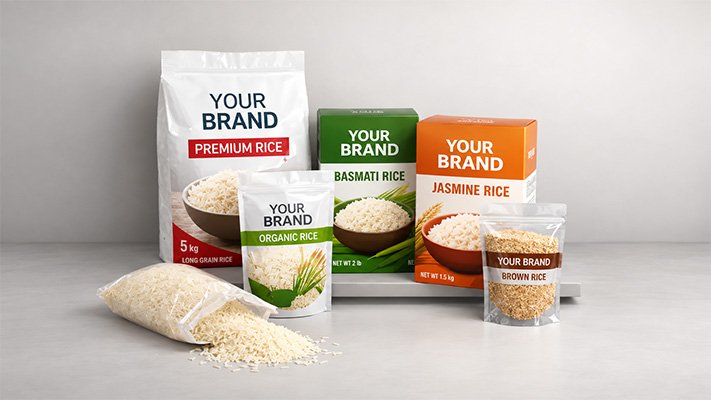
For Indonesian rice mills, we select the bag style first, then focus here on VFFS weight changes.
What Are the Common Types of Rice Packaging Machine?
Different bags need different machines.
Smart Weigh offers vertical packing lines, brick packing machines and premade pouch machines for rice.
Vertical Packing Line
We combine a weigher with a VFFS machine that makes bags from roll film. This option suits pillow bags and gusset bags. We match the forming sets and film widths to your required 1 kg, 2 kg and 5 kg packs.
Brick Packing Machine
We use bag forming, filling, sealing and shaping equipment to produce a neat brick shape. This format gives the rice pack a defined shape for display and stacking. We check the shaping parts and finished pack dimensions for each weight.
Pouch Packing Machine
We fill and seal ready-made bags, such as flat pouches, stand-up pouches and suitable gusset pouches. The machine picks up and opens each bag before filling. We check bag size, opening, gripper capacity and support for heavier portions.
We choose the bag style first, then confirm whether one configuration can cover all three weights. We also review your daily production schedule.
Can the Same Weigher Handle Both 1 kg and 5 kg?
Will your weigher keep up?
We check hopper capacity, feeding and discharge cycles, then test the smallest and largest portions.
We first check how much space your rice occupies. Whole grains and broken rice may behave differently during feeding. We use your sample to check portion volume and flow instead of choosing hopper size from the target weight alone.
A multihead weigher combines rice from several weighing hoppers. Each hopper does not need to hold the full 5 kg. However, the selected combination must reach the target without overloading individual hoppers or needing too many discharge cycles.
Some configurations build a larger portion through repeated discharges. This can extend the weight range, but we need to check the effect on speed.
We also test the smaller portion. A setting that feeds enough rice for 5 kg may feed too much for a stable 1 kg cycle. We adjust feeding and check average overfill. For small grains, we also check hopper gate fit because rice leakage can affect weight control between cycles.
What Needs to Change Between Bag Sizes?
Weight changes affect bags.
Operators change recipes and bag settings. Wider bags normally need another forming set and film roll.
We prepare settings, forming parts and film before stopping production. This helps operators avoid loading incorrect settings. We check print alignment before approving production.
| Item | What Changes |
|---|---|
| Weight | Target, feeding and discharge settings |
| Bag format | Length, width and gusset settings |
| Forming set and film | Match the required width |
| Inspection | Weight limits, guides and reject settings |
If two weights use the same bag width, the forming set may remain in place. Your operator may only need another film roll and a different bag length. We still check whether both portions fit with enough sealing space.
We confirm that the VFFS supports both bag sizes and include all required forming sets.
We save named recipes for each weight and approve trial bags after loading them.
We measure changeover time from the last accepted bag of the previous size to stable production of the next size. This includes adjustments, trial bags and checks.
How Fast Can the Line Run at Each Weight?
Which speed is achievable?
We confirm each weight’s tested speed and include changeovers and normal stops when checking capacity.
We ask which pack size takes most of your production hours. If 5 kg is your main product, its tested output should guide the configuration. A fast 1 kg demonstration will not answer that requirement.
We also check rice supply in kilograms per hour. For the same number of bags per minute, a 5 kg run needs five times the rice flow of a 1 kg run.
You can calculate theoretical output with this formula:
Tonnes per hour = bag weight in kg × bags per minute × 60 ÷ 1,000.
This figure assumes continuous running. Actual shift output also depends on film changes, format changes, material supply and rejected bags.
The larger portion may need more feeding or discharge time. A longer bag may also take more time to form and seal. We test these limits together, then agree on the output for each size using your actual rice and intended production film.
How Do You Keep Rice Out of the Seal?
Grains can weaken seals.
We match filling and sealing timing, leave headspace, and check film strength and bag support.
We check whether the rice finishes falling before the sealing jaws close. If grains continue dropping into the seal, we inspect the discharge timing and filling path. Increasing sealing temperature alone will not remove trapped rice.
Bag dimensions also matter. A bag that is too short may leave little room above the product. We review the filled bag, including how the rice settles, before confirming its length.
For heavier packs, we check how the machine supports and releases the bag. The outfeed should receive it smoothly. A sudden drop can stress the film and seals, so support or discharge adjustments may be needed.
We ask your film supplier to provide the intended production material. We then check the seal with that film and the actual rice portion.
The test should continue after the bag leaves the machine. We inspect packs after conveying and normal handling to check for leakage or seal damage.
What Should You Test Before Confirming the Line?
One weight proves little.
We test every weight with your materials, recording output, weight variation, seals and changeovers.
We recommend a test sequence that follows your planned production. If your team normally runs 5 kg before switching to 1 kg, include that change during the test. This shows whether the operator can complete the required steps and restart reliably.
For each weight, collect a series of finished bags. We check their weights and average overfill, rather than showing only one bag on a scale. We also record rejected packs and the reasons for rejection.
The test should include the outfeed and any supplied inspection equipment. A 5 kg bag must move through these sections reliably, and the reject system must handle it.
Before we prepare your proposal, send the rice sample, bag dimensions, bag style, film specifications and required speed for each weight. We also need your weight tolerance and daily production mix. Smart Weigh can then define the configuration, forming sets and test requirements around your factory’s actual needs.
Conclusion
We choose your bag format, match the main pack, and verify all three weights, changeovers and seals.