
Choosing more weighing heads does not always create a better packaging line. An oversized machine raises cost, while an undersized model can limit output and increase giveaway.
A 10 head multihead weigher usually fits moderate-speed lines and uniform products. A 14 head model provides more weighing combinations, so it is often better for higher speeds, irregular products, multiple pack sizes, and tighter weight control.
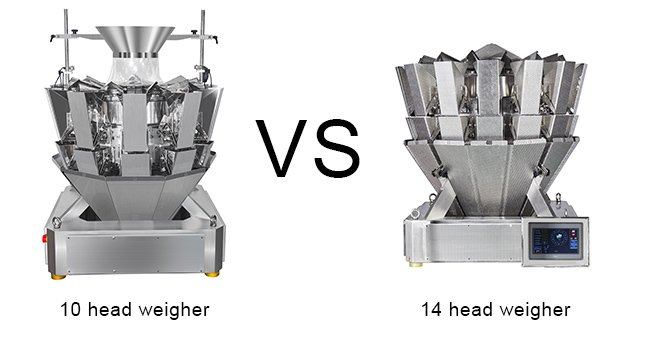
We recommend choosing the number of heads only after checking the product, target weight, required bags per minute, hopper size, packing machine speed, and future production plan. The complete line matters more than one machine specification.
What Is the Main Difference Between a 10 Head and 14 Head Multihead Weigher?
A factory may focus on the four extra heads, but the real difference is the number of weight combinations available for every discharge.
A 10 head model has fewer combinations and normally suits standard-speed applications. A 14 head model can search more combinations, which can improve stable speed, weight accuracy, and giveaway control when the product or target weight is difficult.
| Selection factor | 10 head model | 14 head model |
|---|---|---|
| Production level | Low to medium output | Medium to high output |
| Planning speed | About 30–60 weighments per minute | About 60–120 weighments per minute |
| Combination choices | Fewer | More |
| Product type | More uniform products | More irregular products |
| Weight control | Standard requirements | Better giveaway control potential |
| SKU flexibility | Limited range | Wider range |
| Investment | Lower | Higher |
| Common connection | Standard VFFS or pouch machine | Faster VFFS or high-output line |
These ranges are for early planning. Actual output depends on the product, target weight, hopper volume, discharge design, and packing machine.
A multihead weigher normally forms one portion by combining several weighing hoppers. If a 100 g pack uses three hoppers, a 10 head machine can theoretically form 120 three-hopper combinations. A 14 head machine can form 364. With four hoppers, the difference increases from 210 combinations to 1,001.
Some hoppers may be filling or discharging, so not every combination is always available. Still, more choices help the controller find a suitable result faster for products with different piece weights.
More heads do not correct poor feeding. Sticky, fragile, or large products may need special feeder surfaces, lower drops, or bigger hoppers. Head quantity is only one part of the design.
When Is a 10 Head Multihead Weigher Enough?
Some buyers choose 14 heads because they expect more capacity. However, the extra capacity creates little value when another part of the line limits production.
A 10 head multihead weigher is often enough when the product flows freely, piece weights are consistent, required output is moderate, and the VFFS or premade pouch machine cannot use a faster weighing rate.
A 10 head model can work well for rice, coffee beans, peanuts, seeds, hard candy, small biscuits, dry pet food, regular granules, and selected non-food parts. These products usually move through radial feeders in a stable way, so the controller can create acceptable portions with fewer combinations.
We often consider ten heads when the complete line needs about 30 to 50 packs per minute. This range is common for premade pouch machines. A VFFS machine may also run below the weigher capacity when it produces long bags, thick seals, gas flushing, or heavy packs.
A 10 head model is usually practical when:
- The product is free-flowing and relatively uniform.
- The required speed stays below the stable machine capacity.
- The packing machine is the main speed limit.
- The factory handles few pack sizes.
- The budget and future growth are limited.
Price should not be the only reason to choose ten heads. The supplier still needs to prove stable speed and accuracy with the actual product. A lower purchase price creates no saving if the machine cannot meet production during a full shift.
When Does a 14 Head Multihead Weigher Make More Sense?
Irregular products create different weights in every hopper. With too few combinations, the machine may wait longer or release more excess product.
A 14 head multihead weigher makes more sense for higher output, irregular piece sizes, several target weights, and valuable products where small overweights create a large annual cost.
Common applications include keripik, puffed snacks, mixed nuts, gummies, frozen foods, seafood, and fresh produce. These products vary in shape and weight, so one hopper may be much heavier than another.
More heads give the controller more partial weights to compare, which can reduce waiting time. We usually consider 14 heads when the line needs 60 bags per minute or more. The target should be stable production speed, not a short test result.
A 14 head model also gives more flexibility when one line packs several sizes, such as 25 g, 50 g, 100 g, and 250 g snack packs.
Giveaway can also justify the higher investment. If a line gives away 1 g in every bag at 60 bags per minute, the extra product reaches 3.6 kg per hour and 28.8 kg in an eight-hour shift. This loss becomes important for high-value products.
Still, 14 heads may be unnecessary when the pouch machine runs at 30 to 40 packs per minute, supply is limited, or the factory handles one simple product. We compare output and giveaway savings with the added cost.

How Do Target Weight and Packing Machine Speed Affect the Choice?
A weigher may reach a high speed with a small pack, but the same model can slow down when the target weight, product volume, or bag format changes.
The final line speed is controlled by the slowest process. The weigher, feeder, discharge chute, VFFS machine, sealing system, and product settling time must all support the same stable output.
A larger target weight needs more product movement and hopper capacity. More hoppers may discharge, then need time to refill and stabilize.
Product volume can matter more than weight. A 100 g portion of candy uses much less space than 100 g of potato chips. Bulky snacks may need larger hoppers, a wider chute, a larger forming tube, and more falling time. Without enough space, product can bridge or block before entering the bag.
Very small target weights can also be difficult. If one piece is heavy compared with the target, one extra piece may create a large difference. More heads provide more choices, but no machine can remove the natural weight of one product piece.
The packing machine must be included in the calculation. A 14 head weigher may prepare 90 portions per minute, but a VFFS machine limited to 60 bags per minute will keep the line near 60. A fast bagger also cannot reach 90 bags per minute when a 10 head weigher only supplies 55 stable portions.
Long bags, thick film, gas flushing, labeling, and product settling can reduce bagger speed. The elevator must also provide enough product. We calculate capacity from the complete process, not one machine.
Why Should the Final Decision Use a Real Product Test?
A product name does not show the oil level, seasoning, breakage risk, bulk density, or piece-size range found in actual production.
A real product test shows whether the proposed 10 head or 14 head system can reach the required speed, accuracy, giveaway, product handling, and cleaning results under conditions close to the factory process.
Two factories may both pack potato chips, but their products can behave very differently. One chip may be thick and dry. Another may be thin, oily, and heavily seasoned. The correct feeder surface, hopper size, opening timing, and chute angle can change with these details.
A useful test should use the actual product and important pack sizes. It should include the smallest target, largest target, and most difficult product. The supplier should record stable weighments per minute, average weight, minimum and maximum weight, giveaway, hopper refill performance, sticking, breakage, discharge time, chute blocking, and cleaning time.
The test should also check the connection with the packing machine. A good weighing result has limited value when the product cannot enter the bag smoothly or when the bagger cannot accept the discharge rate.
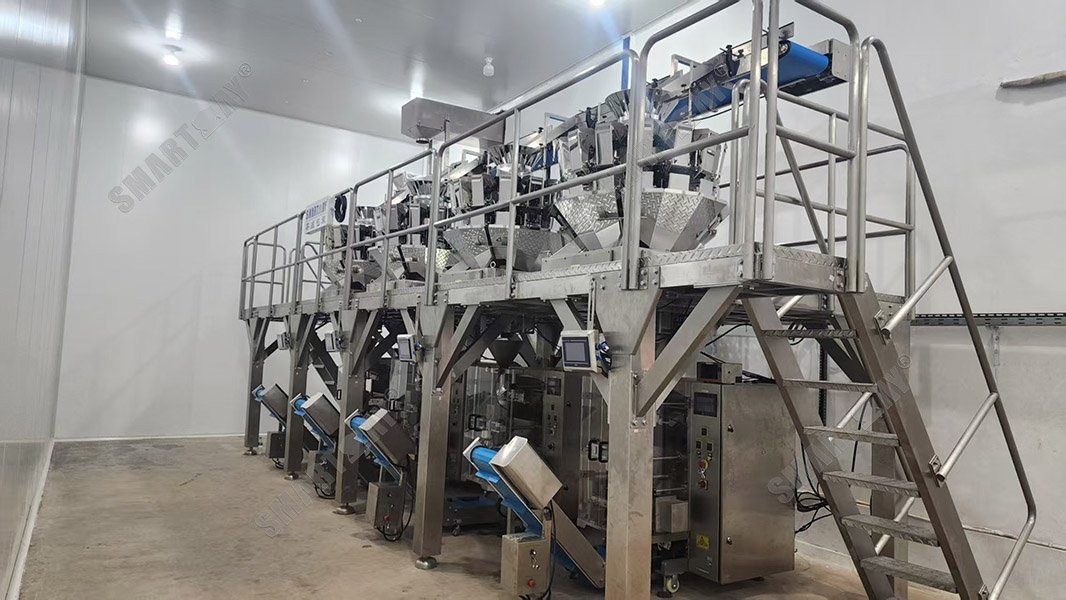
At Smart Weigh Indonesia, we match the number of heads with the hopper volume, feeder surface, discharge design, and packaging machine. We also consider future SKUs and capacity plans. Our China manufacturing base supports factory-level pricing, while our local Indonesian engineers support testing, installation, and after-sales service.
Conclusion
A 10 head model suits moderate output and stable products. A 14 head model suits higher speed, irregular products, wider SKU ranges, and tighter giveaway control. Real product testing should confirm the final choice.