
Many snack factories grow fast, but their packing area stays slow. Labor pressure rises, weight loss grows, and delivery becomes harder to control.
An automatic snack packaging line connects feeding, weighing, packing, inspection, cartoning, case packing, and palletizing. It helps snack factories improve speed, reduce giveaway, reduce labor pressure, and build a more stable production system.
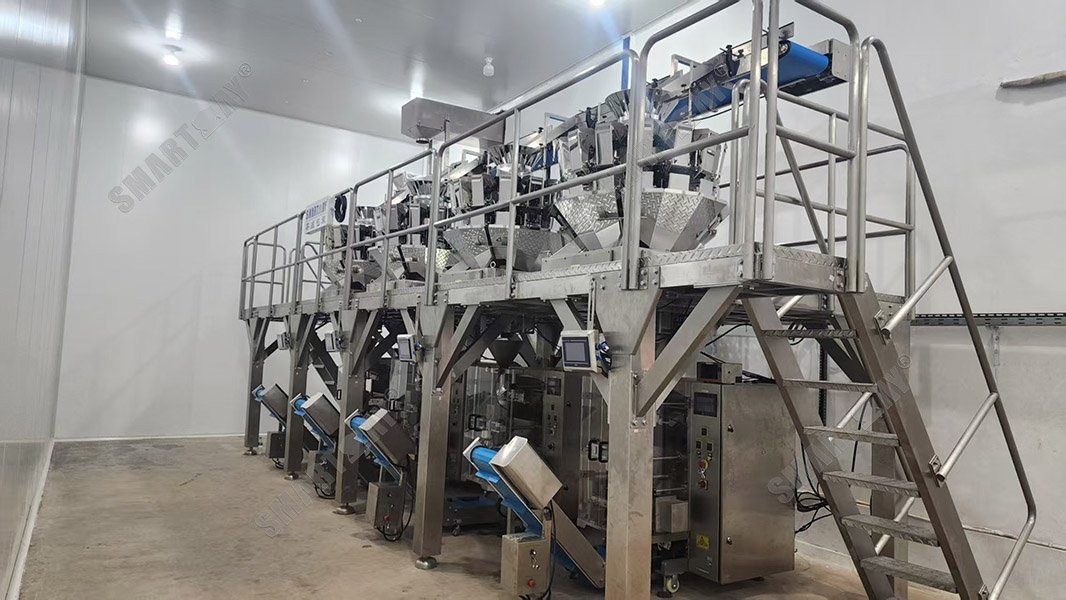
We often see this situation in Indonesian snack factories. The product is strong. The market demand is there. The factory can fry, bake, roast, season, or cool enough product. But the packing area still depends on many workers. This makes the full production flow unstable. A complete automatic snack packaging line solves this problem step by step. It does not only pack bags faster. It also controls product feeding, weighing accuracy, bag quality, carton handling, and final pallet flow. For Smart Weigh Indonesia, this is where real automation value starts.
Why Do Snack Factories Need a Full Automatic Packaging Line?
Manual packing can support small batches, but it becomes weak when order volume grows. Workers get tired, speed changes, and weight accuracy becomes hard to control.
A full automatic packaging line helps snack factories move from manual operation to stable process control. It improves speed, accuracy, quality, and long-term production confidence.
Many snack producers in Indonesia start with manual packing because it feels flexible and easy to manage. This is normal in the early stage. But when the brand enters modern retail, online channels, wholesale supply, or export orders, manual packing becomes a bottleneck. Workers may weigh products by hand, fill bags by hand, seal bags one by one, and count finished packs manually. This process depends too much on people. One shift may work fast. Another shift may create more overweight packs or more broken products.
Snack products also have special handling needs. Chips and keripik are light and fragile. Nuts have higher value. Candy needs clean and fast packing. Mixed snacks need stable weight balance. When the line is manual, these differences are hard to control every day.
| Manual Packing Problem | Factory Impact | Automatic Line Benefit |
|---|---|---|
| Slow hand weighing | Lower daily output | Faster weighing and filling |
| Unstable pack weight | More product giveaway | Better weight control |
| Too many workers | Higher labor pressure | Lower labor dependence |
| Manual sealing | Uneven bag quality | More stable sealing |
| Manual carton handling | Slow dispatch | Smoother end-of-line flow |
At Smart Weigh Indonesia, we see automation as a way to make production more predictable. We do not only look at one machine. We look at the whole line from loose product to finished pallet. This helps the factory reduce waste, protect product quality, and prepare for growth.
How Do Feeding and Weighing Protect Product Flow?
If feeding is unstable, the whole line becomes unstable. Good weighing also starts with good product flow, not only with the weighing machine.
Feeding moves snacks into the weighing system at the right speed. A multihead weigher then combines different weighing heads to reach accurate target weight with less giveaway.
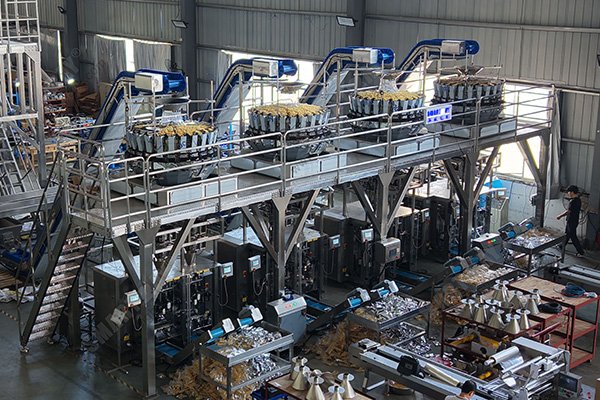
Feeding is the first key step in a snack packaging line. Many factories focus on packing machine speed first, but problems often begin before the product reaches the packing machine. If the feeder sends too much product, the multihead weigher may overload. If the feeder sends too little product, the packing machine waits. If the drop height is too high, fragile snacks may break before packing.
The right feeding system depends on product type. A Z-type bucket elevator can work for many dry snacks. An inclined conveyor may be better for larger or more fragile products. A vibrating feeder can help spread product before weighing. For oily snacks, chili-coated products, or seasoned snacks, easy-clean contact parts are also important.
After feeding, the multihead weigher becomes the center of weight control. It uses several weighing heads to create the closest weight combination. This helps reduce giveaway. For example, 2 grams extra in one bag may look small. But across thousands of bags per day, it becomes a serious product loss. For nuts, dried fruit, premium snacks, and mixed products, this loss can affect profit quickly.
| Product Type | Key Concern | Suggested Focus |
|---|---|---|
| Chips | Breakage | Gentle feeding and bucket design |
| Keripik | Product shape | Low-drop handling |
| Nuts | Product cost | High weighing accuracy |
| Candy | Speed and hygiene | Fast and clean weighing |
| Mixed snacks | Pack balance | Stable combination logic |
Smart Weigh has long experience in multihead weighing and packaging automation. With China-headquarters manufacturing and Indonesian technical support, Smart Weigh Indonesia can help local factories select the right feeding and weighing design before investment. This reduces mistakes and builds trust from the planning stage.
Which Packing Machine Fits Snack Bags Best?
A snack bag is not only a container. It affects shelf image, product freshness, packing cost, and production speed.
Snack factories usually choose VFFS machines for roll film bags or premade pouch machines for stand-up pouches and zipper pouches. The right choice depends on product, market, and budget.
The packing machine must match the business goal. A VFFS machine forms bags from roll film. It is often used for pillow bags, gusset bags, and high-volume snack bags. This solution is suitable for chips, puffed snacks, keripik, and many cost-sensitive retail packs. It gives good speed and lower film cost in many cases.
A premade pouch machine uses ready-made pouches. It is suitable for stand-up pouches, zipper pouches, and premium packaging formats. This is a good option for nuts, dried fruit, healthy snacks, and products that need a stronger shelf image. The pouch cost may be higher, but the package can support a better retail position.
| Bag Style | Suitable Machine | Best For |
|---|---|---|
| Pillow bag | VFFS machine | Chips and puffed snacks |
| Gusset bag | VFFS machine | Larger volume snacks |
| Stand-up pouch | Premade pouch machine | Premium retail snacks |
| Zipper pouch | Premade pouch machine | Resealable nuts or dried fruit |
| Small sachet | High-speed VFFS machine | Small retail packs |
Snack products also need strong sealing. Chips, nuts, and puffed snacks often need freshness protection. Nitrogen flushing can help reduce oxygen inside the bag, but it only works well when sealing is stable. Film material, sealing temperature, bag design, and line speed must work together.
We always ask customers about target speed, pack weight, bag size, film type, shelf channel, and future SKU plans. This makes the recommendation more practical. A factory that sells economy pillow bags should not use the same thinking as a brand that sells premium zipper pouches. Good advice must match the real market position.
Why Should Inspection Be Built Into the Packaging Line?
Fast packing is not enough if poor packs reach customers. A single underweight bag or weak seal can damage brand trust.
Inspection equipment checks weight, metal risk, coding, and package quality. It helps snack factories reduce complaints and protect food safety during daily production.
Inspection should not be treated as an optional accessory. It is part of a stable production system. A checkweigher can inspect finished packs and reject underweight or overweight bags. Underweight packs create customer complaints. Overweight packs create giveaway. Both hurt the factory in different ways.
A metal detector helps reduce food safety risk by checking possible metal contamination. Some lines may also use vision inspection to check date codes, seal position, or bag appearance. A reject system removes unqualified packs without stopping the whole line. This keeps production moving and reduces manual checking pressure.
| Inspection Equipment | Main Function | Factory Benefit |
|---|---|---|
| Checkweigher | Checks pack weight | Reduces underweight and overweight packs |
| Metal detector | Checks metal contamination risk | Supports food safety control |
| Vision system | Checks code or appearance | Reduces wrong or unclear packs |
| Reject system | Removes bad packs | Keeps the line stable |
| Data records | Tracks results | Supports production review |
For Indonesian factories that want to supply bigger retail channels or export markets, inspection can strengthen customer confidence. Buyers want stable quality, not only good taste. When a factory can show better weight control, cleaner packaging, and safer inspection flow, the brand becomes easier to trust.
Smart Weigh Indonesia helps customers consider inspection during line design. This is important because inspection equipment needs space, reject direction, and good connection with conveyors. Planning it early is easier than adding it later in a crowded factory layout.
How Do Cartoning, Case Packing, and Palletizing Complete the Process?
Many factories improve bag packing first, but the back end still moves slowly. Finished bags still need boxes, cartons, pallets, and warehouse flow.
Cartoning, case packing, and palletizing turn finished bags into retail boxes, outer cartons, and stable pallets. They reduce manual handling and improve dispatch efficiency.
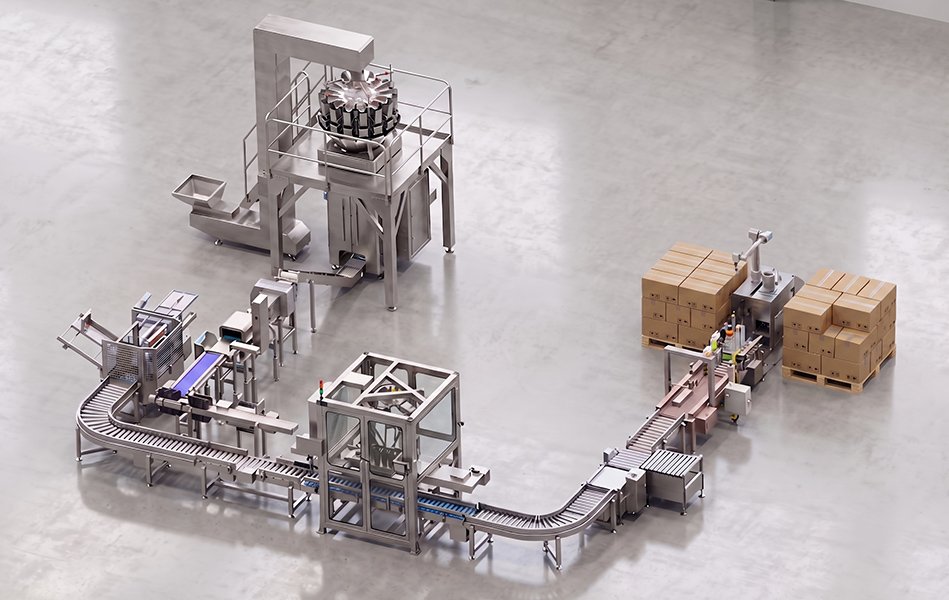
After snacks are packed into bags, the line is not finished. The factory still needs to count bags, arrange them, place them into retail boxes or outer cartons, seal cartons, label cartons, and move finished goods to the warehouse. If this part stays manual, the full line still has a bottleneck.
Cartoning is useful when small snack bags need retail boxes. Case packing is useful when bags or boxes need to be placed into outer cartons. Some factories need a fully automatic case packer. Other factories may need a semi-automatic solution because they handle many SKUs or carton formats.
| End-of-Line Need | Possible Solution | Main Benefit |
|---|---|---|
| Small bags into boxes | Cartoning machine | Better shelf display |
| Bags into cartons | Case packing machine | Faster dispatch |
| Many carton sizes | Semi-automatic system | Higher flexibility |
| High-volume output | Automatic case packer | Lower labor pressure |
| Finished carton handling | Palletizing system | Better warehouse flow |
Palletizing is the final step. It stacks finished cartons onto pallets in a fixed pattern. This reduces repeated manual lifting and improves warehouse order. A robotic palletizer can work with carton conveyors, labelers, and wrapping machines. It helps prepare products for storage, local delivery, or export transport.
We often advise factories to plan the back end early, even if they add it later. A factory may begin with feeding, weighing, and packing first. Then it can add cartoning, case packing, and palletizing as volume grows. This staged plan protects cash flow and keeps future expansion open.
Why Can Smart Weigh Indonesia Be Trusted for Snack Packaging Automation?
Choosing a packaging line supplier is not only about price. It is about project thinking, machine quality, local support, and long-term service.
Smart Weigh Indonesia combines China-headquarters manufacturing with local Indonesian technical support. We provide factory-direct value, full-line experience, and practical support for Indonesian snack factories.
Smart Weigh Indonesia, also known as PT Smart Weigh Packaging Indonesia, supports food manufacturers with weighing and packaging automation solutions. Smart Weigh was founded in 2012 and has delivered more than 1,000 global installations across more than 50 countries, with more than 100 installations in Indonesia. This project experience helps us understand both international standards and local production challenges.
Our advantage is clear. We connect China manufacturing strength with Indonesian service. Customers can get competitive factory-direct pricing without traditional distributor markup. At the same time, they can communicate with a local team that understands Indonesian factories, products, language, and service needs.
| Smart Weigh Indonesia Strength | What It Means for Customers |
|---|---|
| China-headquarters manufacturing | More competitive factory-direct value |
| Local Indonesian support | Easier communication and faster response |
| Full-line project experience | Better machine connection and layout planning |
| 1,000+ global installations | Proven application knowledge |
| 100+ Indonesia installations | Better local production understanding |
| Service hubs including Indonesia | More confidence after installation |
| Fast support promise | Lower pressure when issues happen |
We understand that Indonesian snack factories need practical automation. Machines must handle keripik, chips, nuts, candy, puffed snacks, and many other local products. They must also fit real factory space, cleaning habits, labor conditions, and maintenance routines.
This is why we do not want to be seen only as a machine seller. We want to be a long-term packaging automation partner. We help customers think before buying, support installation after delivery, train operators, and plan future upgrades. This is how Smart Weigh Indonesia builds trust with snack manufacturers who want stable growth.
Conclusion
A complete automatic snack packaging line gives snack factories better speed, better control, safer quality, and more confidence to grow with the right automation partner.