
Frozen nuggets seem easy to pack, but frost, uneven feeding, broken coating, and poor signal control can turn a fast machine into an unstable line.
Smart Weigh designs frozen nugget packaging lines that connect controlled feeding, multihead weighing, VFFS bagging, weight and metal inspection, and finished-bag handling. Every machine must stop and restart in the correct order.
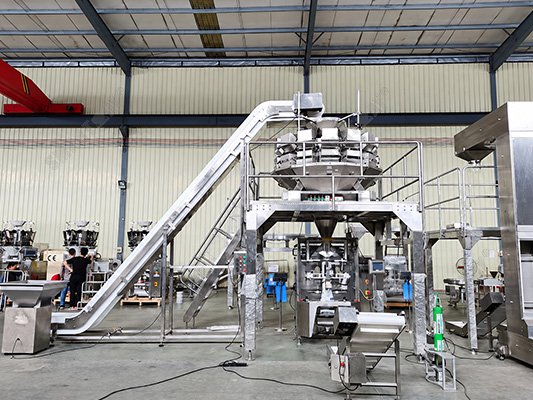
Smart Weigh Indonesia often sees factories focus first on the speed of the packing machine. However, the VFFS machine is only one part of the system. If frozen nuggets arrive too quickly, the weigher becomes overloaded. If they arrive too slowly, the packing machine waits. A stable line starts with balanced product flow.
How Does Smart Weigh Move Frozen Nuggets Through the Complete Line?
Frozen nuggets pass through several transfer points before they become finished bags. A poor transfer point can reduce the performance of every machine after it.
Smart Weigh normally arranges the process as feeding conveyor, multihead weigher, VFFS machine, take-away conveyor, checkweigher, metal detector, and finished-bag collection. Each section must match the speed of the sections before and after it.
| Process | Main Equipment | What Smart Weigh Checks |
|---|---|---|
| Product receiving | Feeding hopper | Capacity and holding time |
| Product lifting | Incline conveyor or bucket elevator | Drop height and feeding stability |
| Portioning | Multihead weigher | Hopper volume and weighing speed |
| Bagging | VFFS machine | Bag size, film movement, and seals |
| Inspection | Checkweigher and metal detector | Accuracy, sensitivity, and rejection |
| Final handling | Collection table or case packing system | Bag spacing and labour requirement |
The design starts with how the nuggets leave the freezer or existing production section. Some factories feed the packaging line in batches. Others have a continuous product flow that cannot stop immediately.
Smart Weigh adds a buffer hopper when temporary storage is needed. However, the hopper should not be larger than necessary. Frozen nuggets held for too long may develop more frost, stick together, or become difficult to feed evenly.
The conveyor should respond to the product-level sensor on the multihead weigher. When the weigher needs more nuggets, the conveyor runs. When enough product is available, it slows down or stops.
Smart Weigh also checks every drop between machines. A high drop can damage the coating and create crumbs. These crumbs may later enter the bag-sealing area. Short and controlled transfers usually produce more stable results.
How Does Smart Weigh Select a Multihead Weigher for Different Bag Weights?
One weigher may handle several target weights, but it will not produce the same speed for every bag. Nugget size and volume are just as important as weight.
Smart Weigh selects the multihead weigher according to nugget dimensions, bulk density, main bag weight, required output, and hopper volume. The main product is checked first, followed by the expected speed of each secondary weight.
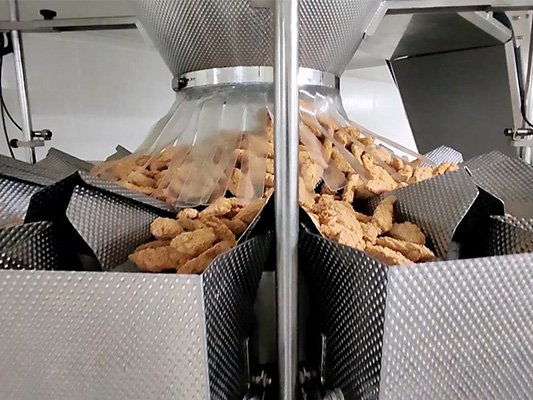
A factory may want to pack 250 g, 500 g, 1 kg, and 2 kg bags on one line. This is possible in many projects, but one common speed should not be expected for all four sizes.
For a smaller portion, the weigher needs enough control to avoid unnecessary product giveaway. For a larger portion, the weigh hoppers must hold enough nuggets. A hopper that performs well with 500 g may not have enough usable volume for a bulky 2 kg portion.
If the hoppers cannot form 2 kg in one cycle, the weigher may need two or more discharges. The final packaging speed will then be lower. This does not mean the machine is unsuitable. It means the factory must first identify its main production weight.
| Bag Weight | Main Point Smart Weigh Checks |
|---|---|
| 250 g | Small-combination control and giveaway |
| 500 g | Stable speed for the main retail format |
| 1 kg | Hopper capacity and discharge timing |
| 2 kg | Hopper volume and required discharge cycles |
Smart Weigh prefers to test actual nuggets whenever possible. A photo cannot show bulk density, frost level, surface oil, or how easily the pieces overlap. During testing, the technical team records speed, average weight, giveaway, product breakage, and feeding stability.
How Does Smart Weigh Keep Bag Filling and Sealing Consistent?
Good weighing does not guarantee a good finished bag. Poor film tracking, incorrect timing, and nuggets entering the seal area can still cause rejected packages.
The VFFS machine forms roll film into bags, receives each weighed portion, and completes the top seal. Pillow bags are widely used for frozen nuggets because they support efficient production and help control packaging-material costs.
Smart Weigh confirms the required bag width and length before selecting the VFFS model. The technical team also checks the film structure, roll diameter, film thickness, and sealing requirements. A 500 g bag and a 2 kg bag may require different forming tubes.
The discharge chute should guide the nuggets into the centre of the bag. It must be wide enough to prevent bridging, but it should not create an unnecessary drop. Smart Weigh also adjusts the timing between the multihead weigher and the VFFS machine. The weigher should release the portion only when the bag is ready.
Crumbs and small coating particles can fall into the horizontal sealing area. If too much product becomes trapped in the seal, the bag may leak. The technical team checks discharge timing, bag length, sealing temperature, sealing pressure, and cooling time during testing.
Smart Weigh uses the customer’s production film for the final test whenever it is available. Nitrogen flushing can also be added when the shelf-life plan requires it, but it is not a standard requirement for every frozen nugget project.
Why Does Smart Weigh Pay Special Attention to Condensation in Indonesia?
Frozen products often enter a warmer packing room. When the surrounding air is humid, the temperature difference can create water on and inside the equipment.
Smart Weigh uses an anti-condensation design to control moisture inside the machine cabinet. This helps protect wiring, terminals, sensors, and electrical components when cold products are packed in warm and humid production areas.
This issue is especially important in Indonesian frozen-food factories. The nuggets may come from a low-temperature area, while the weighing and packaging machines operate in a warmer room. Moisture can then form because of the temperature difference.
A stainless-steel machine does not solve the complete condensation problem. Stainless steel improves hygiene and corrosion resistance, but the electrical cabinet still needs suitable protection.
Smart Weigh frozen-food packaging machines can be equipped with an anti-condensation system. The system helps prevent condensed moisture from reaching wires and control components and causing electrical faults.
Before confirming the design, Smart Weigh asks about the product temperature, room conditions, cleaning method, and distance between the freezer and packaging machine. The technical team also checks whether the factory washes the equipment directly with water.
Removable product-contact parts make cleaning easier. The structure should also allow water to drain instead of remaining around the weighing and feeding sections.
How Does Smart Weigh Keep the Entire Line Running Together?
A line may contain several fast machines and still produce slowly. Actual output depends on signal control, product flow, fault handling, and the slowest repeated process.
Smart Weigh connects product-request, ready, full, run, and fault signals between the machines. If the VFFS machine stops, upstream feeding must pause before nuggets overflow from the weigher or accumulate inside the conveyor.
When the multihead weigher needs product, it sends a request to the feeding conveyor. When the VFFS machine is ready, it allows the weigher to discharge. If the metal detector or take-away conveyor stops, the upstream equipment should also stop safely.
Smart Weigh recommends some extra packaging capacity when the upstream production process cannot stop quickly. For example, a packaging line should not operate continuously at its maximum limit just to match the normal freezer output.
Additional speed allows the line to clear a temporary product build-up after a film change or short stop. A small buffer may also be needed between continuous upstream production and the packaging equipment.
After sealing, the bags move through a take-away conveyor. A checkweigher verifies the weight of each complete bag, while a metal detector checks for detectable metal contamination. Incorrect bags should be rejected automatically.
The finished bags can then move to manual collection, case packing, or a fully automatic end-of-line system. Smart Weigh selects this section according to output, available labour, floor space, and future automation plans.
What Does Smart Weigh Test Before Shipment to Indonesia?
A short video of an empty machine cannot prove that the complete line is ready. The product, film, signals, inspection units, and fault recovery must all be tested.
Before shipment, Smart Weigh tests the main bag size under continuous operation. The technical team also checks secondary weights, seals, line communication, reject devices, alarms, changeovers, and restart procedures.
The factory acceptance test normally covers:
- Actual nuggets or a product with similar size and flow
- The customer’s production film when available
- The main target weight at the required speed
- The smallest and largest secondary weights
- Average weight and product giveaway
- Nugget breakage and coating loss
- Bag dimensions and seal quality
- Checkweigher and metal-detector rejection
- Product shortage and film shortage alarms
- Downstream blockage and emergency stops
- Restart order after a machine fault
- Cleaning access and removable contact parts
Smart Weigh also asks for nugget dimensions, target weights, required output, bag sizes, film details, upstream capacity, floor plans, ceiling height, room conditions, power supply, and compressed-air information.
Smart Weigh Indonesia uses this information to review the line before installation. The local technical team then checks product flow, adjusts timing, trains operators, and supports commissioning after the equipment arrives in Indonesia.
Conclusion
Smart Weigh builds reliable frozen nugget packaging lines by balancing feeding, weighing, sealing, condensation control, signal communication, inspection, and testing with the actual product.