
A new packing machine may create another bottleneck if its feeding process, capacity, and control signals do not match the existing roasting line.
A nuts packing machine should be integrated by matching the complete product flow, actual roasting output, temporary product storage, packing capacity, mechanical connection, and control signals. The packing system should have higher capacity than normal production so it can recover quickly after film changes and short stops.
The main question is not whether the new machine can pack nuts. The real question is whether it can receive the product continuously, communicate with the existing equipment, and recover from short stops without reducing total factory output.
What Should Be Checked on the Existing Roasting Line?
A packing machine cannot be selected correctly until the factory’s existing process and actual output are clearly mapped.
The factory should check the average and peak roasting output, existing conveyors and hoppers, product discharge point, pack sizes, required bag speed, available space, utilities, and current control system. These details determine how the new equipment should connect with the existing line.
Map the Existing Production Process
The first step is to draw the actual production flow. The drawing should include all equipment between roasting and finished packing.
A typical existing process may include:
Roasting → cooling → seasoning → inspection → temporary storage → manual packing
The new process may become:
Roasting → cooling → seasoning → receiving hopper → product elevator → multihead weigher → packing machine → checkweigher → metal detector → finished-bag conveyor
Not every factory has the same process. Some factories transfer roasted nuts directly to a storage hopper. Some use several storage bins for different flavors. Others use workers to move the nuts from roasting to packing.
The integration plan should therefore identify the exact point where the new packing equipment will take over.
| Information to Check | Why It Matters |
|---|---|
| Average roasting output | Determines the normal packing workload |
| Peak roasting output | Determines the minimum required packing capacity |
| Batch or continuous roasting | Affects feeding and storage arrangements |
| Existing hopper capacity | Determines how long nuts can accumulate during a short stop |
| Product discharge height | Determines conveyor or elevator design |
| Product discharge direction | Affects the complete line layout |
| Target pack weights | Determines the required packs per minute |
| Bag styles and dimensions | Determines the suitable packing machine |
| Existing inspection equipment | Determines downstream connection requirements |
| Current PLC and sensors | Determines whether signals can be exchanged |
How Should the New Nuts Packing Line Be Connected?
Adding only a packing machine is usually not enough. The factory also needs a controlled way to feed, weigh, pack, inspect, and discharge the nuts.
The new line normally connects the existing production equipment to a receiving hopper, feeding conveyor, multihead weigher, packing machine, and inspection equipment. Each section should have enough capacity and the correct control signals to maintain stable product flow.
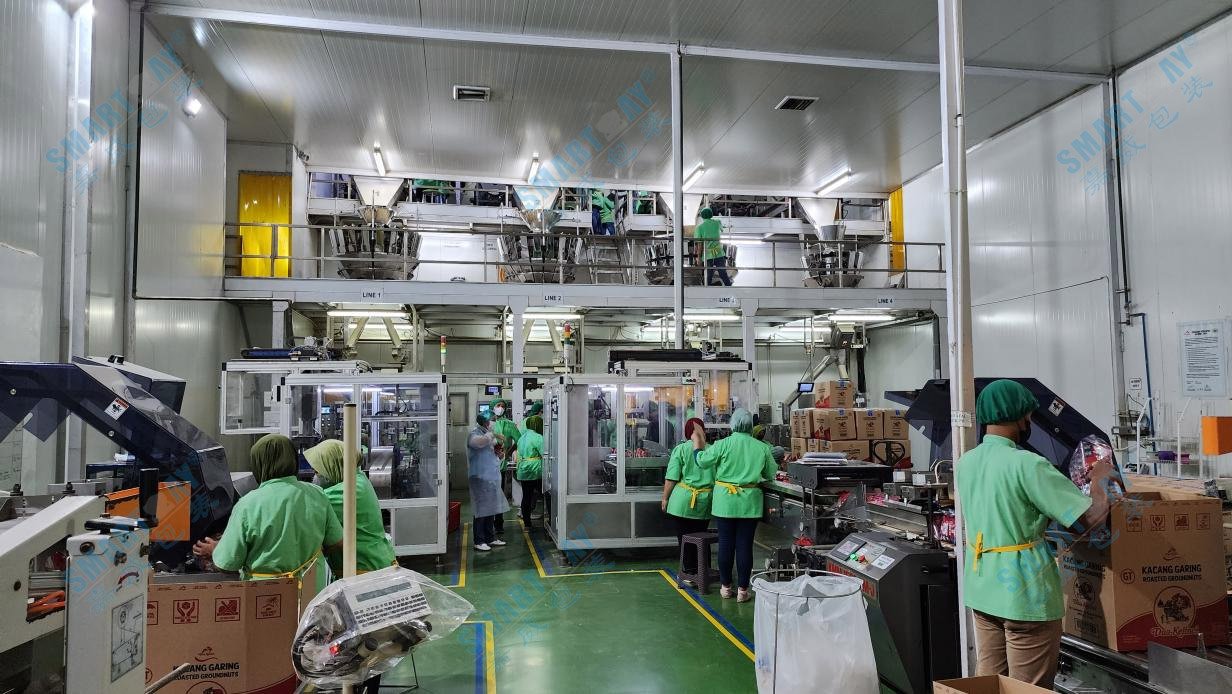
Define the Equipment Flow
The required equipment depends on what is already available in the factory. A typical integration may include:
-
Receiving or feeding hopper
The hopper receives nuts from the existing roasting, seasoning, or storage section. It also provides short-term holding space when the packaging machine stops briefly. -
Product elevator or conveyor
A Z-type bucket elevator, incline conveyor, or belt conveyor transfers the nuts to the weighing system. The correct option depends on the factory layout, product flow, and breakage risk. -
Multihead weigher
The weigher automatically divides the nuts into the required target weight. Its hopper size, number of heads, and discharge speed must match the pack weight and packing capacity. -
Packing machine
A VFFS machine can produce pillow, gusset, or quad bags from roll film. A premade pouch machine can fill stand-up and zipper pouches. A container line may be needed for jars, cans, or tubs. -
Finished-pack inspection
A checkweigher confirms the final weight. A metal detector checks the packed product for metal contaminants. The system can automatically reject failed packs. -
Secondary packing equipment
The line can later connect with bag counting, cartoning, case packing, case sealing, or palletizing equipment.
The new equipment should form one continuous process. The receiving hopper, elevator, weigher, and packing machine should not operate as separate machines that depend on workers to coordinate them manually.
Why Should the Packing Machine Be Faster Than the Normal Roasting Output?
A machine that only matches the average roasting output has no spare capacity after a film change, minor fault, or short production interruption.
The packing system should have a stable operating capacity above the normal upstream output. This extra capacity allows the machine to pack the accumulated nuts after restarting while the roasting line continues producing. It reduces the need to stop the complete production line during short packaging interruptions.
Use Additional Capacity to Recover from Short Stops
Film replacement is a normal part of VFFS production. Operators may also stop the machine briefly to adjust the film, clean the sealing area, change a coding ribbon, or remove an incorrectly formed bag.
The roasting line does not always need to stop during these short interruptions. Nuts can remain temporarily in the existing storage hopper or the receiving hopper before the product elevator. When the packing machine restarts, its additional capacity allows it to clear the accumulated product.
For example:
| Production Condition | Illustrative Capacity |
|---|---|
| Normal upstream output | 400 kg/hour |
| Stable packing capacity | 500 kg/hour |
| Packaging stop | 6 minutes |
| Nuts accumulated during the stop | About 40 kg |
| Additional packing capacity after restart | 100 kg/hour |
| Approximate time to clear the accumulated nuts | 24 minutes |
This example shows why matching 400 kg/hour of production with exactly 400 kg/hour of packing capacity is not enough. The packaging section would never clear the accumulated product unless the roasting line slowed down or stopped.
The required capacity margin should be based on:
- Normal and peak roasting output
- Expected film-change time
- Frequency of short machine stops
- Existing hopper capacity
- Main pack weights
- Stable speed with the factory’s actual nuts and bags
- Future production growth
The factory should not select the machine only by its advertised maximum speed. The supplier should confirm a stable operating capacity using the actual product, target weight, packaging material, coding system, and optional nitrogen flushing.
Where Do the Nuts Go During a Short Packing Stop?
The nuts should remain temporarily in the existing storage hopper, receiving hopper, or feeding hopper before the packaging machine.
A separate large buffer system is not always required. If the existing hopper can hold the output from a normal film change or short stop, the main requirement is a packaging machine with enough additional speed to catch up after restarting.
If the existing line has no temporary holding point, the integration may need a larger receiving hopper. Extra packing speed can clear accumulated product, but there must still be a safe location for the product during the actual stop.
Which Signals Should Be Connected Between the Existing and New Equipment?
Machines may be mechanically connected but still operate poorly if the feeding system, weigher, and packing machine cannot exchange basic production signals.
The required signals normally include machine ready, run permission, product request, high material level, low material level, machine fault, and downstream availability. A simple line may use local level sensors, while a continuous high-output line may require PLC communication and interlocks.
Determine the Required Control Level
The amount of signal integration depends on the factory’s production method.
Basic Local Control
Basic control may be enough when roasted nuts are moved into storage bins before packing. The packaging section operates as an independent process.
The main signals may include:
- Low-level sensor starts the product elevator
- High-level sensor stops the product elevator
- Multihead weigher requests more product
- Packing machine sends a ready signal to the weigher
- Packing machine fault stops product feeding
This arrangement does not always require direct communication with the roasting machine.
Coordinated Line Control
More signal connection is needed when the roasting and packing sections run as one continuous line.
| Signal | Purpose |
|---|---|
| Packing machine ready | Confirms that the machine can receive product |
| Packing machine running | Confirms that normal packing has started |
| Product request | Starts the upstream conveyor or elevator |
| High-level signal | Stops or slows upstream feeding |
| Low-level signal | Requests more product |
| Packing machine fault | Prevents product from continuing to feed |
| Downstream ready | Confirms that finished bags can leave the machine |
| Downstream fault | Stops bag discharge before bags accumulate |
| Emergency-stop circuit | Protects operators and connected equipment |
The integration does not always require both machines to use the same PLC brand. Dry-contact signals, digital inputs and outputs, or an agreed communication protocol may be sufficient.
Before manufacturing, the factory should provide the available PLC information, electrical drawings, signal list, and sensor positions. If this information is unavailable, the supplier should inspect the existing control cabinet or coordinate with the original roasting-line supplier.
How Should the Mechanical Layout and Utilities Be Planned?
Incorrect machine positioning can create long transfer distances, product spillage, difficult cleaning, and poor operator access.
The layout should confirm the existing discharge point, conveyor direction, platform height, ceiling clearance, hopper position, operator access, film-loading space, finished-bag flow, power supply, and compressed-air connection. These points should be approved before the new equipment is manufactured.
Confirm Every Physical Interface
The integration drawing should include both existing and new equipment. It should not show only the new packing machine.
The layout should confirm:
- Height of the existing product discharge
- Position of the receiving hopper
- Conveyor or elevator feeding direction
- Height of the multihead weigher platform
- Factory ceiling height
- Distance between existing and new machines
- Operator access to weighing hoppers
- Space for film-roll replacement
- Cleaning and maintenance access
- Finished-bag conveyor direction
- Checkweigher and metal detector position
- Electrical cabinet location
- Power and compressed-air connection points
- Space for future cartoning or case packing
Product transfer points should also be checked. Large drops can cause nut breakage and product spillage. Poorly positioned conveyors can create dead areas where nuts collect. The transition from the existing line to the receiving hopper should therefore be tested with the actual product.
How Should the Integrated Line Be Tested?
Testing each machine separately cannot confirm whether the complete line will handle short stops, restart correctly, and exchange signals with the existing equipment.
The factory acceptance and site acceptance tests should simulate normal production, peak output, film changes, short stops, hopper-level changes, machine faults, and downstream interruptions. The line should restart automatically and clear accumulated product without stopping the roasting process.
Test Normal Production and Recovery Capacity
The acceptance test should use the factory’s actual nuts, target weights, bags, film, labels, and coding materials.
The test plan should include:
- Normal upstream production output
- Peak production output
- Stable packing speed
- Smallest and largest pack weights
- Film replacement
- Short packing-machine stops
- Product accumulation in the receiving hopper
- Restart at catch-up speed
- High-level and low-level sensor response
- Packing machine fault signal
- Elevator start and stop response
- Downstream conveyor fault
- Checkweigher and metal detector rejection
- Product changeover
- Bag seal quality
- Weighing accuracy
- Continuous production test
One important test is to stop the packaging machine while the upstream section continues running. The test should confirm where the nuts accumulate, how long the hopper can hold the product, and how quickly the packing machine clears the accumulated quantity after restarting.
What Information Should the Factory Provide Before Integration?
Missing information about the existing equipment can cause layout changes, signal problems, delayed installation, and additional factory modifications.
The factory should provide production videos, equipment layouts, average and peak output, pack sizes, existing hopper capacity, discharge dimensions, electrical drawings, PLC information, utility details, and expected short-stop duration. This information allows the new packing line to be designed around the real process.
Prepare an Integration Information List
The factory should provide:
- Nuts and package samples
- Existing production-process diagram
- Videos of the roasting and seasoning line
- Average and peak output in kilograms per hour
- Batch or continuous production method
- Current temporary storage method
- Existing hopper dimensions and capacity
- Product discharge height and direction
- Target pack weights
- Required bag styles and dimensions
- Expected bags per minute
- Current film-change time
- Existing conveyor and inspection equipment
- Factory layout and ceiling height
- Electrical supply and compressed-air information
- PLC brand and available signal information
- Electrical drawings when available
- Planned future capacity
- Required installation and commissioning schedule
Smart Weigh can use this information to define the equipment flow, capacity margin, feeding method, signal list, and physical connection. Local engineers can also inspect the Indonesian factory when the existing line has limited space or incomplete technical drawings.
Conclusion
A successful integration depends on the right equipment flow, additional packing capacity, temporary product holding, reliable signal exchange, and complete testing under real production conditions.