
Choosing the wrong weigher can create hidden production losses. Many manufacturers focus only on machine price, but inaccurate weighing, product giveaway, and limited production capacity can cost much more over time.
The right weighing machine depends on how your product behaves during the weighing process. Linear weighers suit stable products with predictable flow, while multihead weighers are better for products that require high accuracy, speed, and flexibility.
For Indonesian manufacturers, selecting a weighing system is not only a technical decision. It is a production strategy decision. Different products create different weighing challenges. A machine that works well for rice or seasoning powder may not be the best choice for snacks, frozen food, or seafood. Understanding the working principle behind each technology helps factories make a better investment decision.
How Does a Linear Weigher Work and What Products Does It Fit?
A linear weigher uses a simple but effective weighing process. The machine controls product flow through several feeding channels and measures the weight until it reaches the target value.
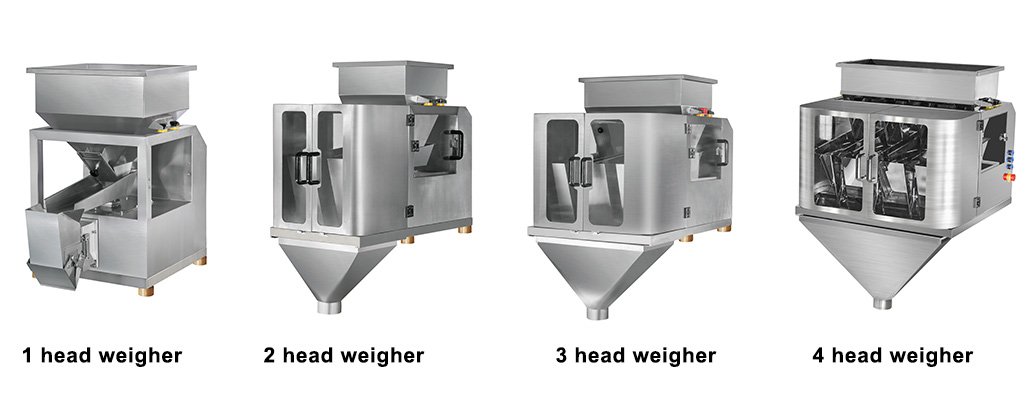
The main idea is controlled filling. The machine adds products into the weighing bucket and stops feeding when the required weight is achieved. This method works well when product characteristics are stable and easy to control.
How Does a Linear Weigher Control Product Weight?
A linear weigher usually works through several steps:
- Products enter the machine through feeding channels.
- The vibration system moves products forward at a controlled speed.
- Products fall into weighing buckets.
- The weighing system measures the product amount.
- When the target weight is reached, the bucket releases the product.
The strength of this system is simplicity.
Because the machine uses fewer weighing units and a simpler calculation method, it has several advantages:
| Advantage | Why It Matters |
|---|---|
| Simple structure | Easier operation and maintenance |
| Lower investment | Suitable for factories controlling equipment cost |
| Stable performance | Works well with consistent products |
| Easy training | Operators can learn quickly |
However, the same working principle also creates limitations. The machine mainly depends on controlling product flow. If the product size, shape, or density changes significantly, maintaining high accuracy becomes more difficult.
For example, if a factory packs coffee beans with similar size and density, a linear weigher can achieve stable results. However, if a factory packs irregular frozen seafood pieces with different weights, the weighing process becomes more challenging.
Why Are Some Indonesian Products Better Matched With Linear Weighers?
The key question is not whether a linear weigher is advanced enough. The question is whether the product requires advanced weighing calculation.
Linear weighers perform well when products have predictable characteristics.
| Product Characteristic | Why Linear Weigher Works |
|---|---|
| Similar product size | Feeding is easier to control |
| Stable product density | Weight calculation is more predictable |
| Moderate production speed | Simple weighing process is sufficient |
| Lower material cost | Small weight differences create limited losses |
Many Indonesian manufacturers produce products that match these conditions.
Examples include:
- Rice.
- Sugar.
- Coffee beans.
- Seasoning granules.
- Seeds.
- Some powder products.
For these applications, using a more complex weighing system may not always create additional value. A linear weigher can provide reliable performance while keeping the investment reasonable.
However, manufacturers should also consider future growth. A product that only needs a simple weighing process today may require higher speed and accuracy when production volume increases.
How Does a Multihead Weigher Work and Why Is It More Flexible?
A multihead weigher uses a completely different weighing concept. Instead of controlling one weighing process, it creates multiple weighing possibilities and selects the best combination.
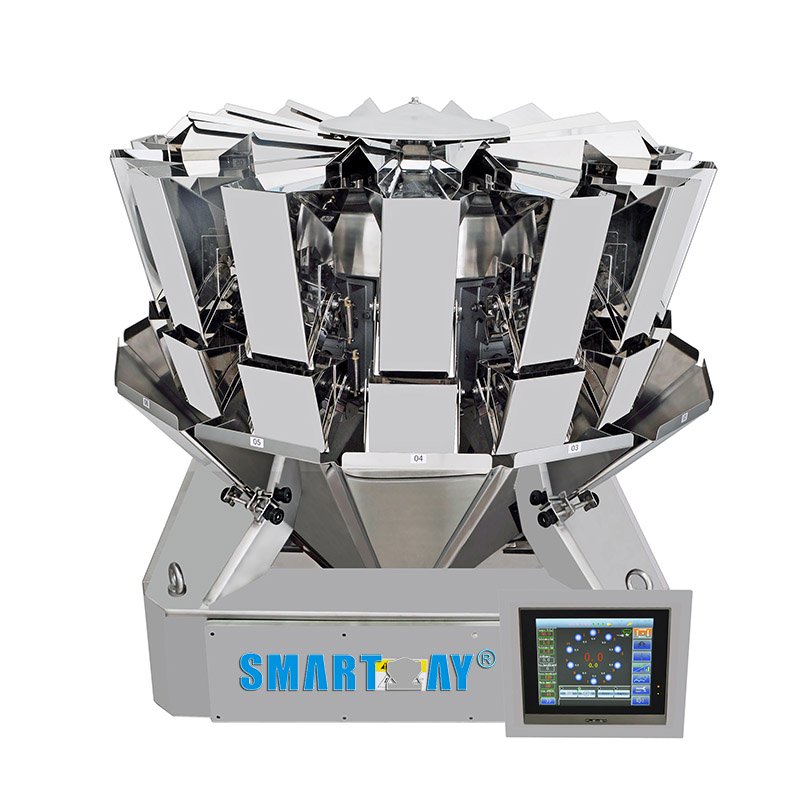
This technology changes the way factories solve the weighing problem.
A linear weigher mainly asks:
"How much product should be added to reach the target weight?"
A multihead weigher asks:
"Which combination of available weights can achieve the closest target weight?"
This difference allows multihead weighers to achieve higher accuracy and speed at the same time.
How Does Combination Weighing Improve Production Performance?
A multihead weigher normally works through multiple weighing heads.
The process includes:
- Products are distributed into different weighing hoppers.
- Each hopper measures an individual product weight.
- The control system receives multiple weight values.
- The software calculates different combinations.
- The machine selects the closest combination to the target weight.
- The selected hoppers release products together.
For example, if the target package weight is 100 grams, the system does not simply add more products until reaching 100 grams.
Instead, it checks different combinations:
- Hopper A: 32 grams
- Hopper B: 34 grams
- Hopper C: 35 grams
- Hopper D: 33 grams
The system selects the combination that reaches 100 grams with the smallest possible error.
This calculation method reduces product giveaway and improves production efficiency.
Why Does Multihead Weigher Perform Better With Difficult Products?
Many Indonesian food manufacturers face products that are naturally inconsistent.
This includes:
- Different product sizes.
- Different product shapes.
- Different product weights.
- Seasonal raw material changes.
These challenges make traditional weighing methods less effective.
Irregular Products Need Flexible Weighing
Products such as keripik, snacks, frozen food, and seafood often have natural variation.
For example, one piece of frozen shrimp may weigh 15 grams, while another piece may weigh 18 grams. A linear weighing system needs to control this difference during filling.
A multihead weigher handles this situation differently.
It does not require every product piece to be the same. It uses different weight combinations to reach the final target.
This makes it suitable for industries where product variation is normal.
High-Value Products Need Better Accuracy
For low-cost products, a few grams of extra weight may not create a major financial impact.
However, for premium products, the situation is different.
Examples:
- Frozen seafood.
- Nuts.
- Dried fruit.
- Premium snacks.
If a factory gives away several extra grams per package, the annual material loss can become significant.
A multihead weigher helps reduce this loss by improving weighing accuracy.
How Should Indonesian Manufacturers Match Weigher Technology With Product Behavior?
The best weighing technology depends on product characteristics and business goals.
Manufacturers should not select equipment only because another factory uses the same machine.
The right question is:
"What problem does my product create during weighing?"
Choose Linear Weigher When Your Product Has Stable Flow
A linear weigher is suitable when:
- Product size is consistent.
- Product flow is predictable.
- Production speed requirements are moderate.
- Investment efficiency is important.
For example, a seasoning producer with stable powder or granule products may not need complex combination weighing.
The factory can achieve reliable production with a simpler system.
Choose Multihead Weigher When Your Product Has More Variables
A multihead weigher is usually a better choice when:
- Product weight varies naturally.
- Accuracy directly affects profit.
- Production speed needs to increase.
- Multiple product formats are required.
- The factory plans future automation upgrades.
For snack manufacturers, frozen food producers, and seafood processors in Indonesia, these factors are often important.
A multihead weigher provides more flexibility when production conditions change.
Why Should Indonesian Manufacturers Consider Future Production Before Choosing a Weigher?
A weighing machine is not only equipment for today's production.
It becomes part of the factory's long-term automation system.
Many manufacturers start with one product but later expand into:
- More packaging sizes.
- More product variations.
- Higher production volumes.
- Export markets.
A machine that only matches today's needs may become a limitation in the future.
How Does Weighing Technology Affect Factory Growth?
When production increases, factories usually face new challenges:
- Manual processes become slower.
- Labor costs increase.
- Product quality becomes harder to control.
- Customers require more consistent weight accuracy.
Multihead weighers provide more flexibility for this growth because they can support higher-speed packaging systems and different product requirements.
Linear weighers remain valuable for manufacturers with stable production conditions. However, companies with aggressive expansion plans should consider whether their current equipment can support future demand.
How Can Manufacturers Balance Investment and Production Efficiency?
The decision between linear weigher and multihead weigher should consider both current investment and long-term return.
| Factor | Linear Weigher | Multihead Weigher |
|---|---|---|
| Initial investment | Lower | Higher |
| Weighing method | Controlled filling | Combination calculation |
| Accuracy | Good for stable products | Higher for variable products |
| Speed | Moderate | High |
| Product flexibility | Limited | Excellent |
| Best application | Stable products | Complex products |
A lower machine price does not always mean lower production cost.
For high-volume manufacturers, reducing giveaway and improving efficiency can create more value than saving initial investment.
The correct weighing solution should match the product, production volume, and future business direction.
Conclusion
Linear weighers fit stable products with predictable flow, while multihead weighers support complex products requiring speed, accuracy, and flexibility. Indonesian manufacturers should choose based on product behavior and future growth needs.