
As every snack factory owner knows, packaging quality is only as good as your weighing system. Get the weighing wrong, and you risk losing profit by overfilling or facing customer complaints with underfilled bags. Multihead weighers are the gold standard for fast, accurate portioning, but choosing the right one can be a bit overwhelming. Do you need 10, 14, or 32 heads? Linear or radial? What bucket shape is best?
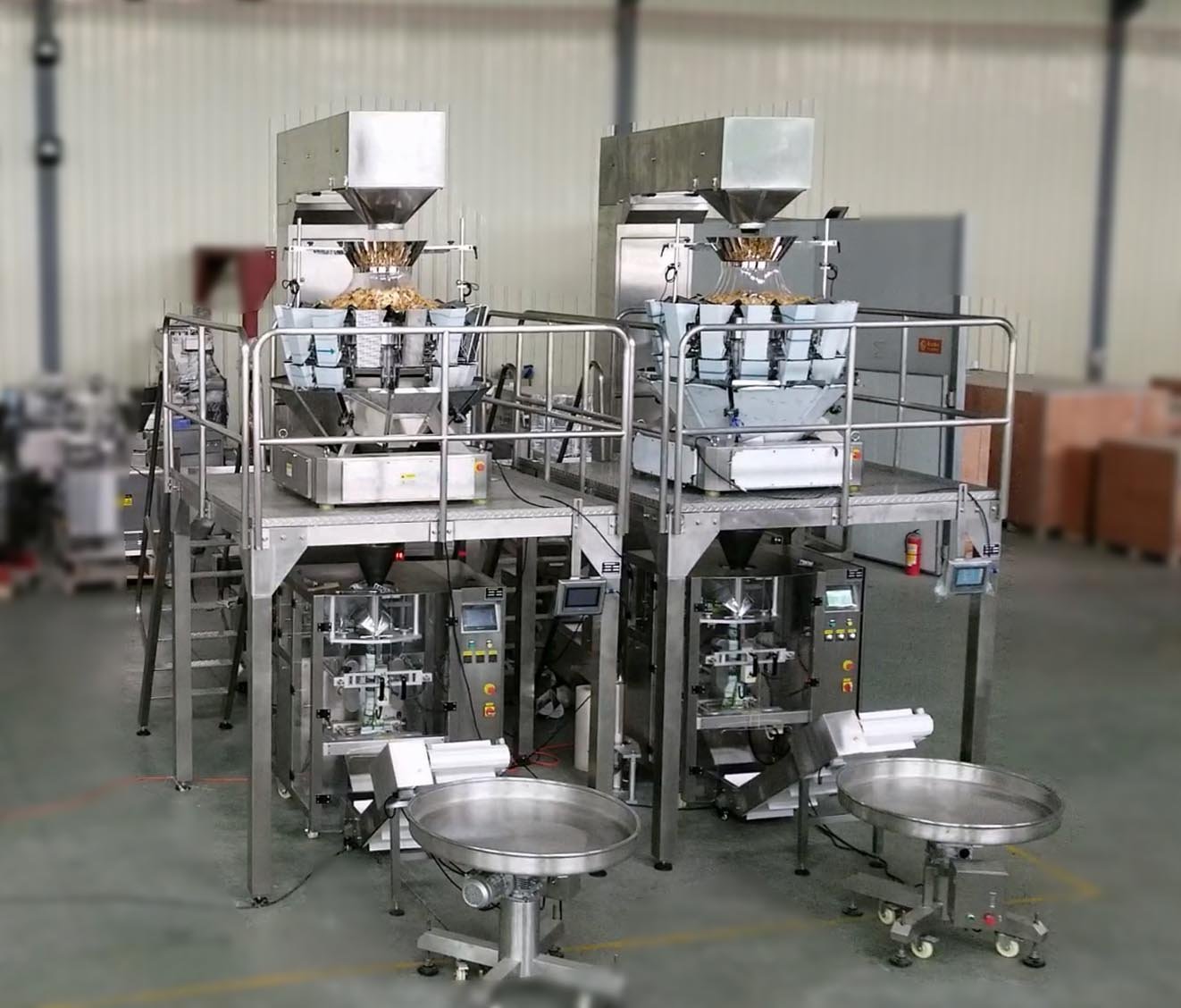
Let's simplify the process and help you pick the right multihead weigher for your factory's needs.
What Does a Multihead Weigher Actually Do?
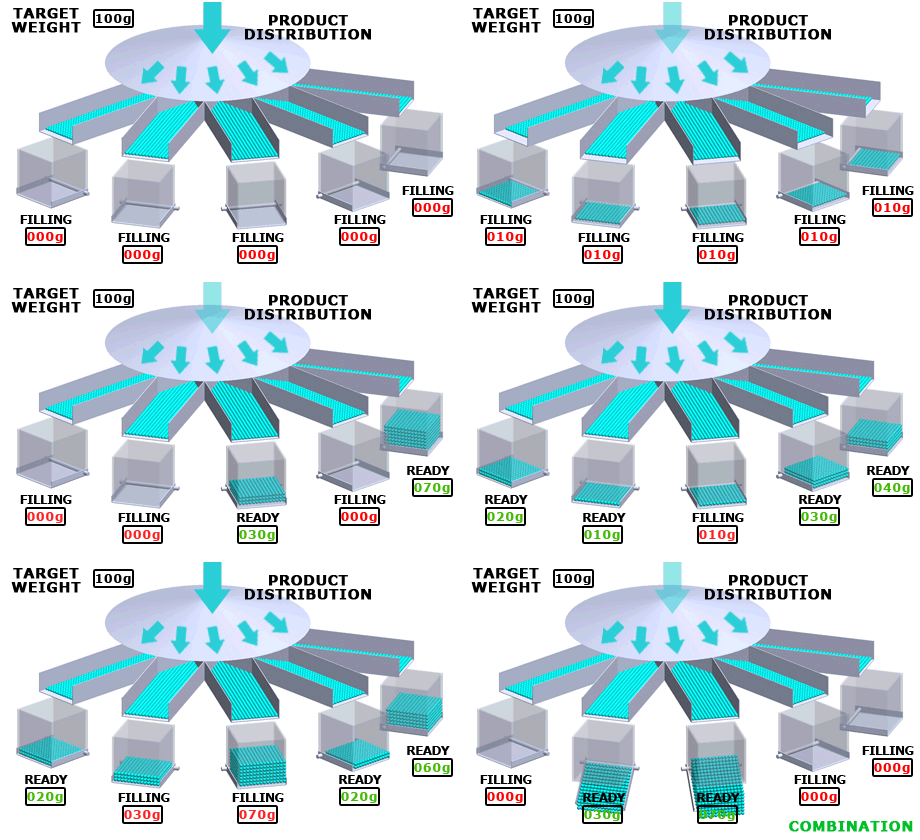
A multihead weigher functions by using multiple small hoppers (the "heads"), each grabbing a portion of your product. A computer then calculates the best combination of these portions to reach the target weight—quickly and precisely.
Imagine trying to weigh 250 grams of nuts: with a manual scale, you'd scoop, check, adjust, and repeat. With a multihead weigher, 14 scales work together, each grabbing a tiny portion and combining them to hit the target weight—within less than a second.
Why it's better than manual weighing:
- Speed: 10+ times faster than manual weighing
- Accuracy: Within 0.1 to 1.5 grams
- Efficiency: Handles tricky products better than single-scale systems
How Many Heads Do You Need?
The number of heads required depends on your production volume and product type.
10-14 Heads: Ideal for Most Snack Factories
For most Indonesian factories producing nuts, chips, and extruded snacks, a 10-14 head multihead weigher is the perfect fit.
Why this range works:
- Speed: 60-100 bags/min (ideal for medium-scale production)
- Cost-Effective: Not overly expensive
- Versatility: Handles a wide weight range (10g to 800g)
- Support: Easy to find spare parts and get technical support
A 14-head weigher can achieve 80-120 cycles per minute, which is sufficient for most medium-scale snack production.
16-32 Heads: When Speed and Precision Matter
If your factory runs at high volumes (100+ bags per minute) or requires extreme accuracy, you might want a 16-32 head weigher.
Consider this setup if:
- Your production goal exceeds 100 bags/min
- You need precise weights for premium products
- You're packaging very light products (under 50g)
- Your production volume justifies the higher cost
The trade-off: More heads mean higher costs, increased complexity, and more maintenance.
Fewer Than 10 Heads: Consider Alternatives
If your production is small-scale or straightforward, a linear weigher might be more cost-effective and better suited for simple products.
Matching Your Weigher to Your Snack
Choosing a multihead weigher based on specs alone isn't enough. You need to consider the specific nature of your product.

For Nuts and Seeds
Nuts are relatively uniform and flow well. What you need is:
- Precision: Accuracy within ±0.5 to ±1g
- Anti-stick Coating: Essential for oiled or seasoned nuts
- Bucket Shape: Standard buckets usually work fine
Recommended Setup: 10-14 head weigher with standard buckets
For Chips (Fragile Products!)
Chips break easily, so gentle handling is key. The machine should minimize vibration and reduce the distance the chips travel.
What to Look For:
- Shallow Buckets: Minimize drop height
- Reduced Vibration: Too much shaking leads to broken chips
- Shorter Drop Paths: Reduce impact during the drop
Recommended Setup: 10-14 head weigher with shallow buckets and reduced vibration
For Mixed Products
Trail mixes and snack combinations are the trickiest to handle due to varying product sizes and weights.
What to Look For:
- Sophisticated Combination Algorithms: Advanced software that optimizes for mixed products
- Larger Hoppers: To handle volume variations
- Variable Speed: Slows down for better mixing
Recommended Setup: 14+ head weigher with advanced combination logic
Key Specs Explained
Accuracy
How close you get to your target weight every time.
- ±0.1 to ±0.5g: Premium accuracy (ideal for expensive or high-end products)
- ±0.5 to ±1g: Standard for most snack products
- ±1 to ±1.5g: Acceptable for bulk or wholesale products
For most Indonesian snack factories, ±1g is sufficient, and going tighter usually costs more without significant benefits.
Speed
Measured in "cycles per minute" (CPM) or "dumps per minute" (DPM).
A 14-head weigher typically achieves 60-120 cycles/min, depending on:
- Product type (nuts are faster than chips)
- Target weight (lighter products are faster)
- Bucket configuration
For example, at 80 cycles/min and an average of 2 heads per cycle, you can pack 160 bags/min, which is enough for most snack lines.
Weight Range
Make sure your weigher can handle the full range of your product weights:
- Most multihead weighers handle 10g to 1kg
- Some can go as low as 1g or as high as 5kg
Be mindful of the minimum weight your weigher can handle. If you're packaging small portions (e.g., 20g), avoid using a weigher designed for larger sizes.
IP Rating
This tells you how resistant the weigher is to dust and moisture:
- IP65: Standard for most food applications; resistant to light dust and splashes
- IP66/IP67: For harsher environments
For most snack factories, IP65 will suffice.
Integration: Making It All Work Together
A great weigher is only half the battle; it must integrate smoothly with your existing production line.
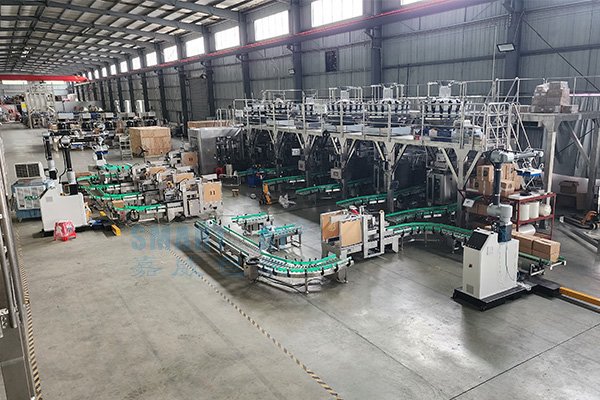
Connecting to VFFS Machines
Your weigher must "communicate" with your bagging machine:
- Signal connection: The bagger signals when the bag is ready
- Timing: Product drops when the bag is in position
- Speed Matching: Weigher output must align with bagger speed
Make sure the equipment uses compatible signals.
Upstream: Getting Product to the Weigher
How is the product delivered to the weigher?
- Elevators lift product from ground level
- Z-bucket conveyors gently transport fragile items
- Vibratory feeders evenly distribute products onto weighing plates
Your supplier should assist in designing the entire product flow.
Downstream: After Weighing
- Checkweigher: Verifies that each bag is within weight tolerance
- Metal Detector: Identifies metal contamination
- Case Packer: Groups bags into cartons for shipping
Ensure your system is designed to allow for future expansion if needed.
Maintenance Tips for Indonesian Factories
Regular maintenance ensures the weigher operates at peak efficiency. Here's a simple routine:
Daily Checks:
- Clean hoppers and discharge chutes
- Check for product buildup on sensors
- Verify accuracy with test weighings
Weekly Tasks:
- Check vibration settings
- Inspect bucket seals
- Clean the entire weighing area
Spare Parts to Keep On Hand:
- Feed wheels and belts
- Proximity sensors and load cells
- Sealing gaskets
- Filters for pneumatic systems
Make sure your supplier can provide local support and keep parts readily available in Indonesia.
Making Your Decision
To choose the right multihead weigher for your factory:
- Know your volume: How many bags per minute do you need?
- Know your product: Is it nuts, chips, or mixed products? This impacts head count and bucket type.
- Know your budget: More heads = more cost. Only go for more heads if you need the speed.
- Know your support: Does your supplier provide local support and spare parts?
For most Indonesian snack factories producing nuts, chips, or extruded snacks, a 10-14 head weigher is usually the best option. It's fast enough, accurate enough, and cost-effective.
The best way to be sure? Test the weigher with your actual product. Many suppliers offer test runs to ensure the machine meets your specific needs. At the end of the day, the most important spec is: Does it work with YOUR snack?