
Walk into any minimarket in Indonesia, and you'll notice a clear difference in snack packaging. Some snacks are packaged in flat, easy-to-stack pillow bags, while others stand proudly on the shelf in stand-up pouches. Though both serve the same purpose—packaging snacks—these formats convey very different messages to consumers.
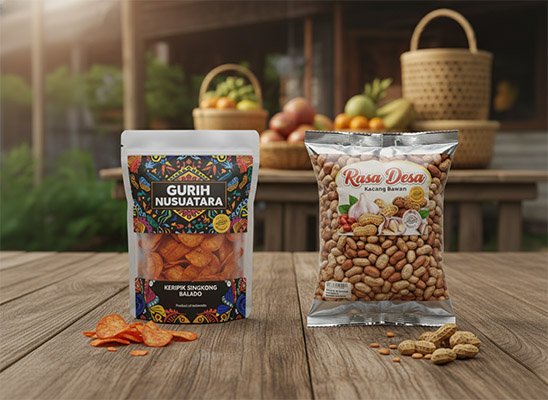
So, which one is the best fit for your product? Let's break it down.
What Are We Talking About Exactly?
Pillow Bag
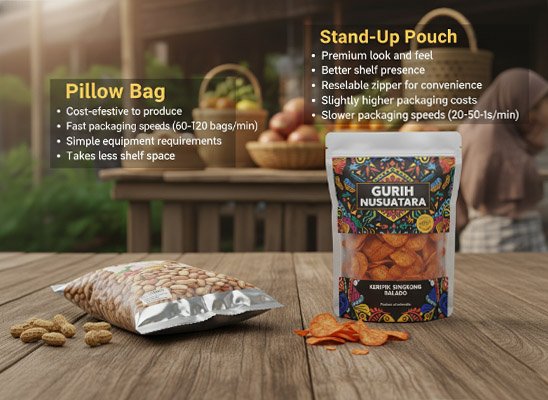
The pillow bag is the classic, flat packaging design. It's a simple tube of film that's sealed at the sides and the bottom (and top) and lies flat when filled.
Key Characteristics:
- Cost-effective to produce
- Fast packaging speeds (60-120 bags/min)
- Simple equipment requirements
- Takes less shelf space
Stand-Up Pouch
Also known as a "doypack," the stand-up pouch features a gusseted bottom that allows it to stand upright on the shelf. These pouches often include a resealable zipper for freshness.
Key Characteristics:
- Premium look and feel
- Better shelf presence
- Resealable zipper for convenience
- Slightly higher packaging costs
- Slower packaging speeds (20-50 bags/min)
When to Choose Pillow Bags
You're Selling to Wholesalers
If your customers are distributors, warungs (small shops), or bulk buyers, pillow bags are the better option. They are cheaper per unit, ship efficiently, and buyers in wholesale markets are often more concerned with value than with premium presentation.
High Volume, Lower Price Point
If your focus is on moving large quantities at competitive prices, packaging costs matter. Pillow bags are typically 20-30% cheaper than stand-up pouches. When you're producing thousands of units, these savings add up quickly.
Traditional Snack Brands
For classic Indonesian snacks like kerupuk, keripik, and onde-onde, pillow bags are a great choice. The traditional look of these bags signals authenticity, which resonates well with many customers while keeping costs affordable.
Speed Matters
Pillow bag machines are faster than stand-up pouch machines, often running at 2-3 times the speed (60-120 bags/min vs. 20-50 pouches/min). If your goal is high-volume production, the speed difference is a significant advantage.
When to Choose Stand-Up Pouches
You're Targeting Modern Retail
In retail settings like Alfamart and Indomaret, products compete for attention on the shelves. Stand-up pouches stand out better and give your snack a more premium appearance, making it ideal for retail markets where shelf presence matters.
Resealability is Important
Unlike pillow bags, which are hard to reseal once opened, stand-up pouches often come with a zipper for resealing. This is crucial for snacks that are consumed over time, like mixed nuts or large snack packs, ensuring freshness for future use.
Premium Positioning
If your snack brand is positioned as premium—using better ingredients, higher quality, and a higher price point—then the packaging needs to reflect that. Stand-up pouches signal a higher-quality product to consumers.
Different Sizes, Same Equipment
Premade pouch machines often allow factories to run different pouch sizes with minimal changeover. This flexibility is valuable for factories offering multiple SKUs and needing versatility on the same equipment.
The Real Numbers: Cost Comparison
Packaging Material Costs
| Format | Material Cost (Approx.) |
|---|---|
| Pillow Bag | Rp 800-1,500/pack |
| Stand-Up Pouch | Rp 1,200-2,500/pack |
Note: These are rough estimates and can vary based on size, film quality, and order volume.
Equipment Investment
| Machine Type | Price Range (Approx.) |
|---|---|
| VFFS (Pillow) | Rp 300-600 million |
| Premade Pouch | Rp 400-800 million |
Production Speed
| Format | Typical Speed |
|---|---|
| Pillow Bag | 60-120 bags/min |
| Stand-Up Pouch | 20-50 pouches/min |
What About Indonesian Consumers?
Modern Trade = Stand-Up Pouches
In retail chains like Alfamart, Indomaret, and hypermarkets, stand-up pouches dominate snack aisles. They offer a premium, visible presence that consumers associate with quality.
Traditional Trade = Pillow Bags
In warungs and traditional markets, pillow bags are still preferred. Price is a key factor, and presentation is less of a concern.
The Middle Ground
Some factories use both! They may use pillow bags for wholesale distribution and stand-up pouches for retail. This allows them to target different channels with the appropriate packaging.
Making Your Decision
Here are a few important questions to ask yourself when choosing between pillow bags and stand-up pouches:
1. Where will most of my product be sold?
- Minimarkets and supermarkets → Stand-up pouch
- Wholesale and traditional warungs → Pillow bag
2. What is my price point?
- Budget-friendly → Pillow bag
- Premium positioning → Stand-up pouch
3. Is the product eaten in one sitting or over time?
- One sitting (small packs) → Either format works
- Over time (larger packs) → Stand-up pouch with zipper
4. How important is speed vs. presentation?
- Need high volume, lower cost → Pillow bag
- Need premium look, willing to sacrifice some speed → Stand-up pouch
5. What's my budget for equipment?
- Lower initial investment → VFFS for pillow bags
- Can invest more → Premade pouch machine
A Quick Note on Hybrid Options
Some VFFS machines can be adapted for stand-up pouches with special tooling, although this setup is less common. Also, many factories start with pillow bags, prove their product in the market, and later upgrade to stand-up pouches as they grow. The packaging decision doesn't always have to be permanent.
The Bottom Line
There is no one-size-fits-all answer. The choice between pillow bags and stand-up pouches depends on your product, your target market, and your business goals.
Choose pillow bags if:
- You're focused on volume and cost efficiency
- Your customers are in wholesale/distribution
- Traditional markets are your main channel
Choose stand-up pouches if:
- You're targeting retail shelves
- Premium positioning matters
- Resealability adds value for your customers
Many successful Indonesian snack factories strategically use both packaging formats depending on the market. Understanding your customers and matching your packaging to the specific channel is key to choosing the right option.