
Indonesia’s snack market is moving faster every year. More SKUs, smaller pack sizes, and stronger price pressure are now normal. At the same time, buyers notice inconsistent weight, broken product, and messy packs faster than before. A multihead weigher can solve many of these issues—but only when the model matches snack behavior, stable production targets, and the packing machine type (VFFS, pouch, or jar packing).
The right selection improves stable output, reduces giveaway, and keeps daily operation smoother. The wrong selection often looks “cheap” at purchase, then becomes expensive through downtime, unstable speed, and frequent cleaning stops.
Why Does Choosing the Right Model Matter in Indonesia?
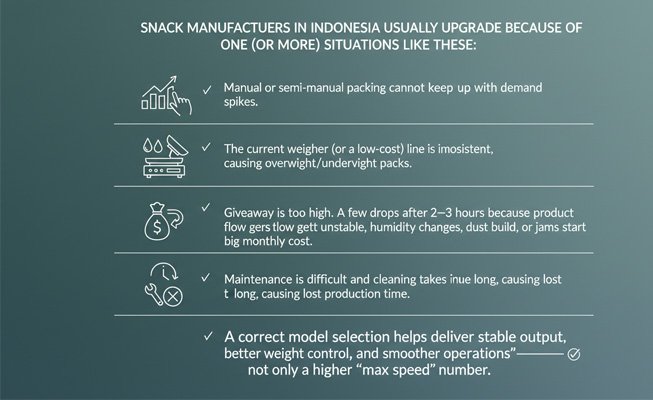
Snack manufacturers in Indonesia usually upgrade because of one (or more) situations like these:
- Manual or semi-manual packing cannot keep up with demand spikes.
- The current weigher (or a low-cost line) is inconsistent, causing overweight/underweight packs.
- Giveaway is too high. A few grams per bag becomes a big monthly cost.
- Speed looks good on paper, but drops after 2–3 hours because product flow gets unstable, humidity changes, dust builds up, or jams start.
- Maintenance is difficult and cleaning takes too long, causing lost production time.
A correct model selection helps deliver stable output, better weight control, and smoother operations—not only a higher “max speed” number.
What Is a Multihead Weigher and How Does It Work?
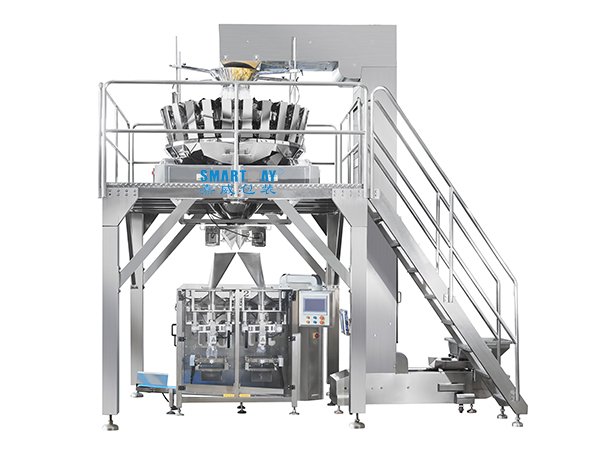
A multihead weigher is an automated weighing system designed to weigh and dispense products quickly and accurately. It is widely used for chips, kerupuk, crackers, nuts, candies, and mixed snacks.
How it works (simple version)
- Product feeding & dispersion: The product spreads evenly across the top cone and feed channels.
- Pre-feeding: Product goes into pool hoppers (pre-hoppers) to stabilize flow.
- Weighing hoppers: Each hopper measures weight with load cells.
- Combination calculation: The controller selects the best combination of hoppers to hit target weight with minimum error.
- Discharge: Selected hoppers release product into the packing machine.
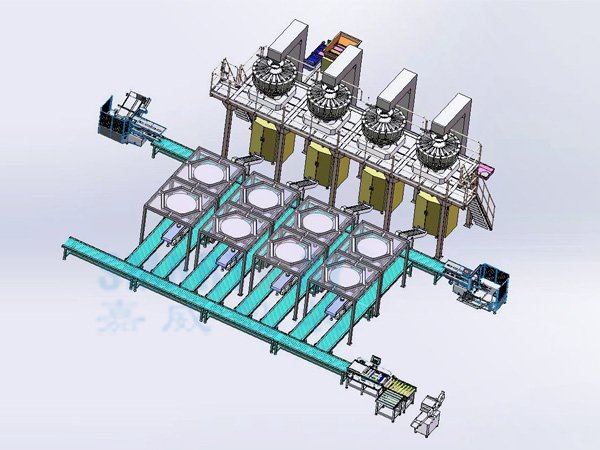
Typical snack line setups in Indonesia
- Multihead weigher + VFFS (vertical form-fill-seal) for pillow bags, gusset bags, and many high-volume snack SKUs
- Multihead weigher + pouch packing machine for premade pouches (zipper, stand-up, etc.)
- Multihead weigher + jar packing machine for rigid containers/jars, usually with controlled discharge to reduce spill and mess
 |
 |
 |
Step 1: How Do You Define Your Snack Product “Personality”?
Snack “personality” decides feeder style, hopper design, and anti-problem features. When this step is skipped, selection becomes guessing, and guessing is expensive.
Common snack categories and the real risks
| Snack type | Examples (common in Indonesia) | Main risk in production | What to prioritize |
|---|---|---|---|
| Fragile | chips, kerupuk, crackers, puffed snacks | breakage, crumbs, unstable flow | gentle feeding, short drop distance |
| Oily / seasoned | coated peanuts, spicy coated chips, flavored mixes | stickiness, seasoning buildup | easy-clean design, anti-stick surfaces |
| Dusty | seasoning-heavy snacks, crumb products | dust contamination, sensor issues | covers, clean cable routing, hygiene access |
| Mixed shapes/sizes | mixed nuts, snack mixes | separation, uneven distribution | stable dispersion, higher head count |
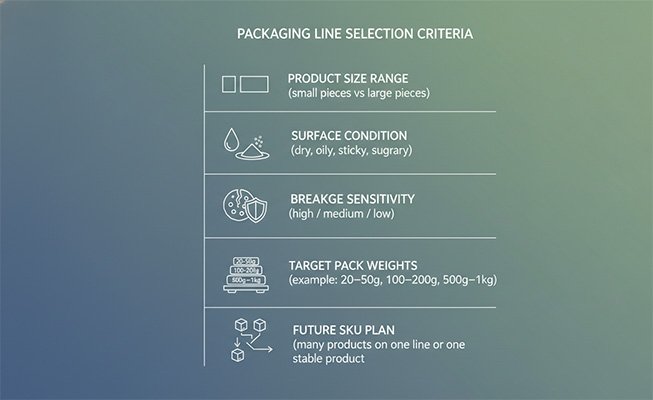
Parameters to confirm before choosing a model
- Product size range (small pieces vs large pieces)
- Surface condition (dry, oily, sticky, sugary)
- Breakage sensitivity (high / medium / low)
- Target pack weights (example: 20–50g, 100–200g, 500g–1kg)
- Future SKU plan (many products on one line or one stable product)
After Step 1, feeder type and hopper style can usually be narrowed down without guessing.
Step 2: How Do You Set a Real Production Target (Stable Speed, Not Peak Speed)?
Many suppliers can quote an attractive “maximum” speed. The number that matters is stable output during real production.
Ask these questions:
- How many bags/jars per minute are needed consistently for a full shift?
- How often will SKUs and pack sizes change?
- Is the goal high speed for one SKU, or flexible production across many SKUs?
Balance speed, accuracy, and giveaway
- Higher speed helps, but if it increases breakage or causes frequent stops, real output drops.
- Tight accuracy reduces giveaway, but if it slows the line too much, capacity suffers.
A practical rule: select a configuration that hits required stable speed with 10–20% headroom for future growth.
Step 3: Which Head Count and Hopper Size Fit Your Snacks?
Head count and hopper volume strongly affect speed stability and accuracy.
Head count (what it usually means in snack packing)
| Head count | Best for | Notes |
|---|---|---|
| 10-head | budget lines, lower speed, simpler products | less flexibility for mixed snacks and wide weight range |
| 14-head | most snack factories (balanced speed + flexibility) | still needs correct feeding to stay stable |
| 16–20 head | high speed, tighter tolerance, mixed snacks | higher cost, needs good integration and operator skill |
Hopper size (match pack weight and product density)
- Smaller hoppers often help lightweight packs and high-speed small bags.
- Larger hoppers support heavier packs or bulky products and reduce weigh-hopper “starvation.”
If different pack sizes run on the same line (like 30g sachets and 200g bags), stable performance across both usually requires the right combination of head count, hopper size, and feeding control.
Step 4: Which Feeding System Works Best for Your Snacks?
In real production, feeding is where many snack lines fail. If product flow is not consistent, speed becomes unstable and accuracy suffers.
Vibratory feeding (common for snacks)
Works well for many dry snacks and nut products. Key points:
- Adjustable vibration for gentle feeding
- Strong dispersion to prevent stacking
- Smooth chute design to reduce breakage
Belt feeding (helpful for fragile or sticky snacks)
Useful when controlled movement and lower impact are needed—especially for fragile, coated, or sticky items.
Snack-specific features worth checking
- Anti-breakage design: shorter drop distance, gentle discharge, controlled vibration
- Anti-stick options: surface treatments, hopper angles, timing control, easy-clean structure
- Dust management: covers, cleaner cable routing, easy access for daily cleaning
One common factory reality: when operators must constantly “babysit” feeder settings, output looks unstable even if the weigher is technically capable. Feeding must match product behavior, or daily production becomes stressful.
Step 5: What Hygiene and Material Choices Match Indonesian Factory Conditions?
Factory conditions vary widely—humidity, heat, seasoning dust, and long operating hours. The model should match cleaning routines and the environment.
Material selection
- SUS304 is commonly sufficient for many snack applications.
- SUS316 can be considered for harsher conditions, aggressive cleaning chemicals, or special products.
Cleaning and maintenance efficiency
Look for:
- Tool-less or quick-release parts for daily cleaning
- Easy access to hoppers and chutes
- Fewer hidden corners where seasoning builds up
Environmental durability
- Better protection for electronics
- Thoughtful wiring and component placement
- Strong build quality for long shifts
If a machine is difficult to clean, cleaning quality drops. Then performance drops. Then unplanned stops happen. Design should fit real human routines.
Step 6: How Do You Check Integration Fit (So You Don’t Choose the Weigher Alone)?
A multihead weigher is only one part of the line. Total line performance depends on integration with the packing machine and factory layout.
A) Match with your packing machine type
Multihead weigher + VFFS
- Discharge timing must match jaw cycle and sealing rhythm.
- Bag style requirements must be clear (pillow, gusset, etc.).
- Film feeding and VFFS speed must not bottleneck the weigher.
Multihead weigher + pouch packing machine
- Premade pouch machines have their own rhythm: feeding, opening, filling, sealing.
- The weigher must deliver consistently at a speed the pouch machine can accept.
- Dust control matters for seasoning-heavy snacks.
Multihead weigher + jar packing machine
- Jar filling needs controlled discharge to reduce spill and mess.
- Anti-static or anti-bounce design may be needed depending on product.
- Jar conveyor and indexing must match the weigher’s output pattern.
B) Layout and maintenance access
In real factories, performance drops when:
- Operators cannot reach critical points easily
- Cleaning areas are too tight
- Maintenance requires too much disassembly
A good supplier should discuss footprint, height, operator flow, and where the team will stand during daily operation.
[elementor-template id="1227"]
How Do You Verify the Supplier and Model Before Buying?
Before committing, avoid relying only on brochures. Ask for proof and a clear acceptance plan.
Request a product test plan (sample trial)
Provide:
- Snack samples (or representative product)
- Target weights and allowed tolerance
- Desired stable speed
Evaluate:
- Weight consistency over time
- Breakage rate
- Stability after warming up
- Cleaning time and ease
FAT/SAT checklist (Factory + Site Acceptance)
- Stable output at pack weights
- Acceptable accuracy/tolerance
- Smooth feeding without frequent jams
- Operator-friendly cleaning and maintenance
After-sales readiness (critical in Indonesia)
Confirm:
- Spare parts availability
- Remote troubleshooting process
- Training plan for operators/technicians
- Clear warranty terms and response expectations
Red flags
- Supplier avoids integration questions
- Only talks about “max speed” without asking product details
- Unclear parts support and commissioning plan
What Model Direction Usually Fits Each Snack Type?
Use this as a starting point, then validate with real sample testing.
- Chips / crackers / puffed snacks: anti-breakage feeding, gentle discharge, stable dispersion
- Coated peanuts / seasoned snacks: anti-stick design, easy-clean structure, dust/seasoning control
- Mixed nuts / snack mix: stable distribution, often higher head count for consistent combinations
- Small sachets (20–50g): stable high-speed performance, precise combination control without stressing flow
Conclusion
The best multihead weigher choice comes from matching snack behavior, stable output needs, and line type. That combination reduces giveaway, improves stability, and makes cleaning and maintenance realistic.
For a model recommendation that fits real factory conditions, share:
- Snack type (photo/video helps)
- Target pack weight range
- Required stable output (bags/jars per minute)
- Current packing machine type (VFFS / pouch / jar) and available space
The Smart Weigh Indonesia Team (smartweighpack.id) can propose the right multihead weigher configuration and a practical line layout. The goal is stable speed, manageable cleaning, and maintenance-friendly operation for Indonesian production teams.