
Frozen shrimp may look easy to pack, but surface ice, moisture, irregular sizes and different pouch weights can quickly make a standard line unstable.
For most 500 g, 1 kg and 2 kg frozen shrimp products, I recommend a multihead weigher with a premade pouch machine. Premade flat pouches are the most common choice. The exact configuration depends on shrimp size, surface glaze, bag dimensions and required output.
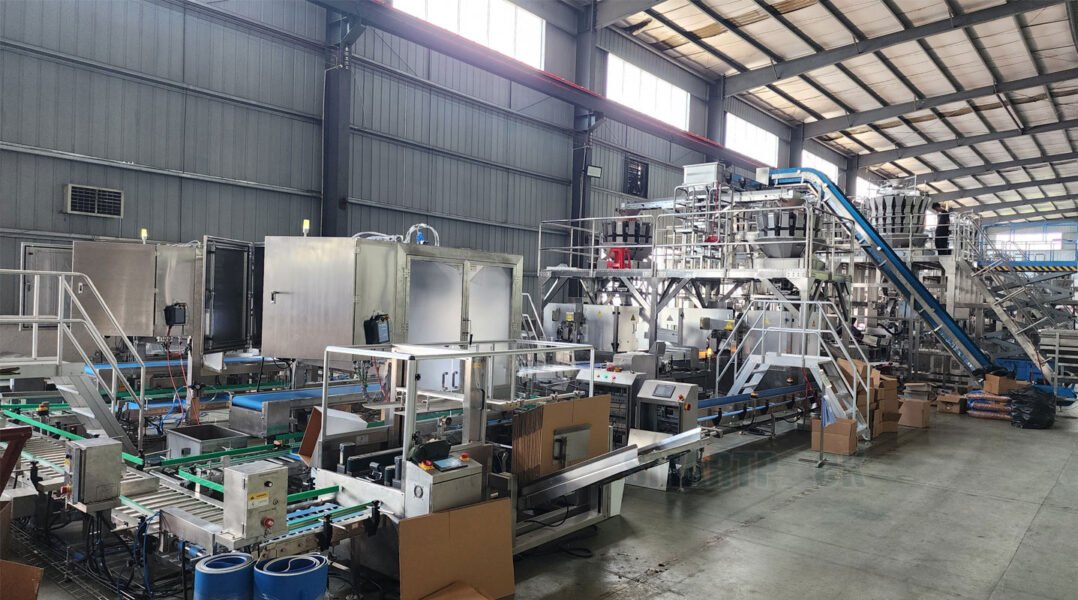
Introduce a common Indonesian project scenario. The customer has several shrimp sizes and three pack weights. The factory needs one line that can change products without sacrificing weighing accuracy, seal quality or daily output.
What Machine Configuration Works for Frozen Shrimp?
A generic packing machine may work during a short demonstration but become unstable when wet, glazed shrimp run continuously.
A typical frozen shrimp packaging line includes controlled product feeding, a multihead or belt combination weigher, a premade pouch machine, date coding, checkweighing and metal detection. Each part must match the shrimp size, moisture, target weight and pouch dimensions.
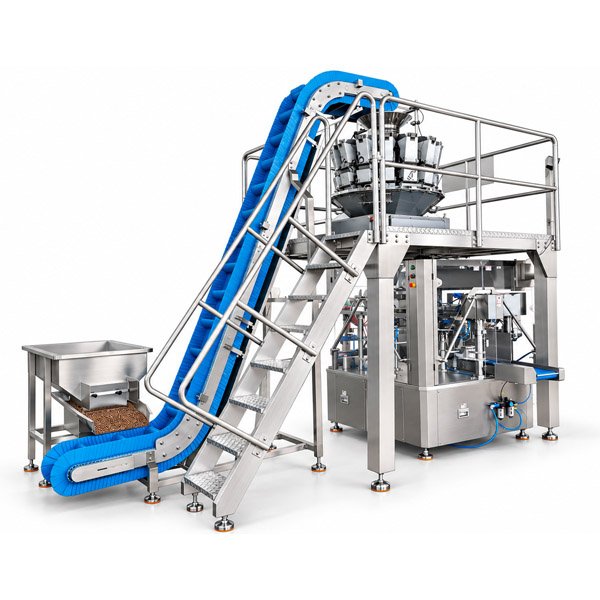
Present the recommended process:
Product feeding → incline conveyor → multihead weigher → premade pouch packing machine → metal detector → checkweigher → finished pouch collection
| Process | Recommended equipment | Main purpose |
|---|---|---|
| Product supply | Controlled feeding conveyor | Prevent sudden overfeeding |
| Temporary storage | Shallow buffer or controlled hopper | Receive shrimp during short stops |
| Portioning | Customized multihead weigher | Control weight and reduce giveaway |
| Bag filling | Premade pouch machine | Open, fill and seal flat pouches |
| Coding | Date printer | Add production and expiry information |
| Inspection | Checkweigher and metal detector | Reject incorrect or contaminated packs |
| Collection | Finished pouch conveyor | Transfer sealed packs for case packing |
Explain that individually frozen, free-flowing shrimp usually suit a multihead weigher. Large, heavily glazed or easily clumped shrimp may need wider feeders, larger hoppers or a belt combination weigher.
Why Are Premade Pouches More Common for Frozen Shrimp?
Choosing the wrong bagging method can create an unfamiliar retail package or make wet shrimp harder to fill and seal consistently.
Premade pouches are widely used for frozen shrimp because the finished bags provide a familiar format for retail and foodservice products. They also support several film structures, printed designs and pack sizes.
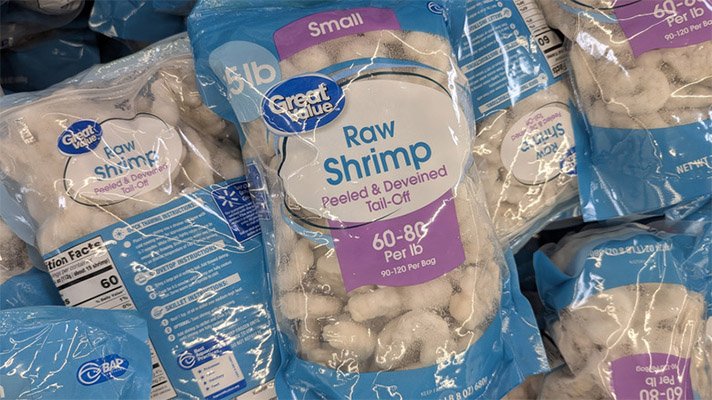
Use this section to correct the assumption that VFFS is always the first choice for frozen shrimp. For a wider format comparison, see Stand-Up Pouch vs. Pillow Bag.
| Packaging format | More suitable applications | Main advantage | Main consideration |
|---|---|---|---|
| Premade flat pouch | Frozen shrimp and seafood | Familiar seafood package with flexible film options | Pouch cost is normally higher than roll film |
| Stand-up or zipper pouch | Premium retail frozen seafood | Stronger shelf presentation and resealability | Not required for every frozen product |
| VFFS pillow bag | Meatballs, fish balls and other free-flowing frozen products | Lower roll-film cost and continuous bag production | Less commonly selected for frozen shrimp |
| Vacuum pouch | Selected seafood products requiring vacuum presentation | Compact package with reduced air | Requires a different filling and vacuum process |
Explain that the final decision should follow the customer’s current market package. A shrimp processor already supplying supermarkets in flat pouches should not change to pillow bags only because a VFFS machine has a lower film cost.
Also explain that a VFFS solution can still be considered when the customer already uses pillow bags, requires continuous high-volume production, or has suitable shrimp and film. It should be presented as an alternative, not the default recommendation.
Can One Line Pack 500 g, 1 kg and 2 kg Bags?
A machine that can reach all three target weights may still require too much adjustment or lose speed during daily SKU changes.
One frozen shrimp line can normally pack 500 g, 1 kg and 2 kg products when the weigher range, hopper volume, pouch size range and discharge system are selected together. Operators can save weight recipes, but pouch changes and mechanical adjustments may still be required.
Cover the following points:
Saved weighing recipes
The control system can store feeding and weighing settings for different target weights and shrimp sizes.
Pouch size changes
The premade pouch machine must support the full width and length range. Operators may need to adjust the pouch magazine, grippers, opening device and filling position.
Hopper capacity
A hopper suitable for 500 g may not have enough volume for a bulky 2 kg portion. The hopper size should be selected using both product weight and bulk volume.
Different production speeds
A 500 g package requires more machine cycles to pack the same hourly tonnage. A 2 kg package needs fewer cycles but requires a larger product discharge.
Include a verified performance table when FAT data are available:
| Pack weight | Verified stable speed | Weighing accuracy | Pouch dimensions |
|---|---|---|---|
| 500 g | Add FAT result | Add FAT result | Add actual size |
| 1 kg | Add FAT result | Add FAT result | Add actual size |
| 2 kg | Add FAT result | Add FAT result | Add actual size |
Keep the existing 400 g case data separate. Do not present the 400 g speed as a verified 500 g result.
Which Weigher Should Be Used for Frozen Shrimp?
The number of weighing heads alone cannot determine whether the equipment will handle frozen shrimp reliably.
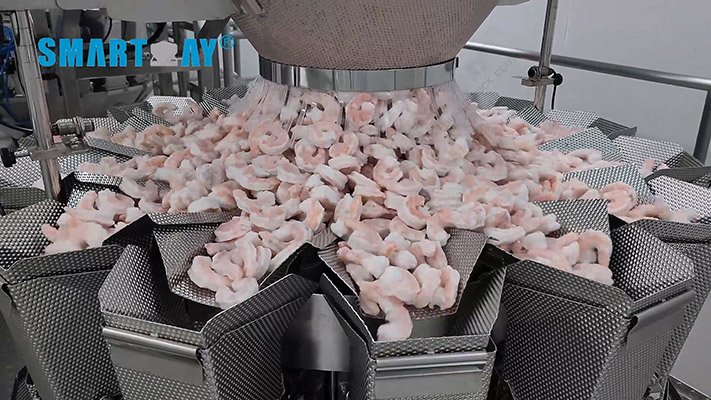
A multihead weigher is usually suitable for individually frozen shrimp that can move through vibratory feeders. A belt combination weigher may be more suitable for large, sticky or irregular shrimp that do not feed reliably by vibration. Product testing should confirm the final choice.
| Shrimp condition | Suggested weighing method | Required design focus |
|---|---|---|
| Individually frozen and free-flowing | Multihead weigher | Stable vibration and suitable hopper size |
| Light surface glaze | Customized multihead weigher | Textured surfaces and controlled feeding |
| Large or irregular shrimp | Large-hopper multihead or belt weigher | Wider product path |
| Sticky or partially clumped shrimp | Belt combination weigher | Active belt feeding |
| Fragile premium shrimp | Gentle multihead or belt weigher | Lower impact and controlled discharge |
Explain how shrimp count size affects hopper selection. Large shrimp occupy more space even when the target weight remains unchanged. Also cover textured contact surfaces, customized drop angles, wider chutes and removable food-contact parts.
How Do We Keep Shrimp and Ice Out of the Seal Area?
A well-weighed portion can still become a rejected pack if shrimp, water or ice remains between the sealing surfaces.
The line should release each shrimp portion as one controlled drop after the pouch is fully open. A suitable chute, synchronized filling time and enough settling time help keep shrimp and loose ice below the sealing area before the pouch closes.
Cover:
- Confirming that the flat pouch is fully open before filling
- Matching the filling chute to the pouch opening
- Avoiding a long or narrow product path
- Discharging the portion in one controlled cycle
- Allowing enough time for the shrimp to settle
- Rejecting pouches that fail to open
- Monitoring seal temperature, pressure and time
- Checking for ice, moisture and product contamination
- Testing the customer’s actual pouch material
Make it clear that increasing machine speed cannot solve poor product transfer. The weigher discharge, chute, pouch opening and sealing cycle must work as one process.
How Does the Machine Handle Cold and Humid Conditions?
A stainless-steel frame does not prevent condensation from forming inside the electrical cabinet.
Smart Weigh frozen food machines include an anti-condensation device inside the electrical cabinet. It helps reduce moisture caused by temperature differences between the cabinet and the production area, protecting wiring, terminals, sensors and control components from moisture-related damage.
Explain why this matters in Indonesia. Frozen shrimp may arrive at the packing line at a very low temperature, while the surrounding air remains warm and humid. Condensation can form after several hours even when the machine looks dry during a short test.
Cover:
- Anti-condensation protection inside the cabinet
- Protected load-cell and sensor connections
- IP65 configuration where required
- Removable hoppers and contact parts
- Direct washdown requirements
- Drainage around conveyors and platforms
- SUS304 as the standard hygienic choice
- SUS316 options for higher corrosion resistance in seafood applications
Use a real photograph of the anti-condensation device instead of only showing the machine exterior.
The hygienic layout and cleaning plan should also be checked against recognized guidance. The FAO/WHO Codex list includes specific codes for both quick-frozen foods and fish and fishery products.
How Should the Packing Line Connect with an Existing IQF Freezer?
If the packing machine stops while the IQF freezer continues running, shrimp can accumulate, clump and rise in temperature.
The packing system should have enough speed reserve, controlled buffering and basic signal communication to receive the IQF freezer’s output. High-level, low-level, ready, run and fault signals help coordinate feeding without unnecessarily stopping the complete freezer.
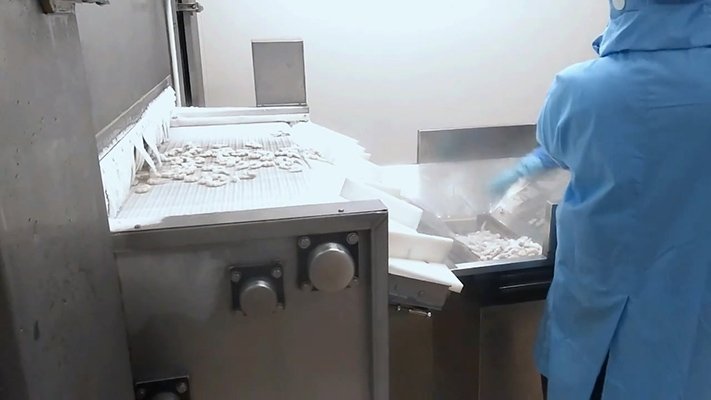
Keep this section focused and concise to avoid repeating the existing integration article.
Cover:
- Actual freezer output instead of rated maximum output
- Product accumulation during pouch changes
- Shallow buffering to limit product pressure
- High-level and low-level controls
- Packing-machine fault signals
- Speed reserve for clearing accumulated shrimp
- Coordination with existing conveyors
For more detail on buffering, signals and speed reserve, read How to Integrate a Frozen Food Packing Machine with an Existing IQF Freezer?
What Should Be Tested Before Confirming the Machine?
A dry machine run cannot show whether real frozen shrimp will stick, break, contaminate seals or reduce the stable output.
The FAT should use the customer’s actual shrimp, premade flat pouches and target weights. I check stable speed, weight results, pouch opening, filling, seal quality, product damage, stop-and-restart performance and cleaning access before confirming the final configuration.
Include an FAT checklist:
| Test item | What should be confirmed |
|---|---|
| Continuous production | Stable output without product buildup |
| Weight test | Average weight, variation and product giveaway |
| Pouch opening | Reliable opening of actual flat pouches |
| Filling test | No shrimp trapped near the pouch mouth |
| Seal inspection | No ice, moisture or product in the seal |
| Product check | No unacceptable breakage or surface damage |
| SKU changeover | Practical change between 500 g, 1 kg and 2 kg |
| Stop-and-restart test | Controlled recovery without hopper overflow |
| Cleaning test | Operators can remove and clean contact parts |
| Condensation check | Electrical components remain protected |
Show real FAT photographs, running videos and weighing records where customer confidentiality allows.
Processors that export seafood to the United States should also review the official FDA Fish and Fishery Products Hazards and Controls Guidance when preparing their HACCP and inspection requirements.
What Information Should a Shrimp Processor Send Before Requesting a Proposal?
A quotation based only on “frozen shrimp, 1 kg” cannot confirm the right hopper, pouch machine, speed or line layout.
I ask customers to provide shrimp size, product temperature, surface glaze, target weights, pouch samples, required output and existing equipment details. These data allow our engineers to prepare a practical machine configuration, layout and testing plan.
Request the following information:
- Shrimp type and count size
- Whole, headless, peeled or processed condition
- Product temperature during packing
- Surface glaze and moisture
- Whether shrimp arrive individually frozen or clumped
- Target weights
- Premade flat pouch dimensions
- Pouch material and sample bags
- Required bags or kilograms per hour
- Existing IQF freezer output
- Available floor space and ceiling height
- Cleaning method
- Required checkweigher, metal detector or case packing equipment
- Product photos and production videos
Finish with a project-specific CTA:
Send Smart Weigh Indonesia your frozen shrimp details, pouch samples and required capacity. Our team will review the complete process and recommend a weighing and premade pouch packaging configuration for your factory.
Conclusion
The right frozen shrimp line combines product-specific weighing, reliable flat-pouch handling, clean sealing, cold-environment protection and verified performance across every required pack size.